In the interest of exploring the history of the Planet Jendar I’ve been quickly building up some skirmish forces for their horse and musket era.
I’ve also picked a three nation conflict of Reddina and the Su Khan Royalists versus The Rin Empire and the Su Khan Separatists, also known as the Su Khan Civil War, or in Su Khan ‘The War of the Three Dragons’. Rin and Reddina put forward a few of their own troops, but mainly it was a case of those two nations equipping and training their backed faction. The Rin Empire were really the founders of what later came to be known as the Jendari Collective, and Reddina was home to House Baranor.
I’ve always been interested in musket combat ever since I was a kid battling with Italeri Plastic Napoleonic figures while on holiday, probably influenced by my seeing of the film Waterloo at an early age, and later on seeing the battle scenes from the Patriot when I was a little older. What I love especially is that because the weapons are so inaccurate at range in a skirmish there must have been this risk vs reward factor. Getting closer to the enemy means you have a better chance of hitting, but of also being hit, so you better hope you do… because if you miss it’s going to take you a while to reload!
To reflect this I’ve drawn up some simple rules, and I hope to try them out some point this week:
Each skirmish force should have between 12 and 20 figures, all figures are armed with Muskets. I’m including rules for mounted figures, although I don’t use any.
During their turn a player can activate each of their figures once, and when activated each figure can perform one action:
Move, Shoot, Charge, Fight, Reload or Rally.
Moving is simple, the figure can move up to 20cms. Mounted figures move 30cms.
Shooting is also simple, select a target for the figure firing and measure the distance between shooter and target in cms. Roll a D100 if the result is equal to or greater than the distance then a hit has been achieved. Roll a D6 and consult the table below, taking into account the cover of the target:
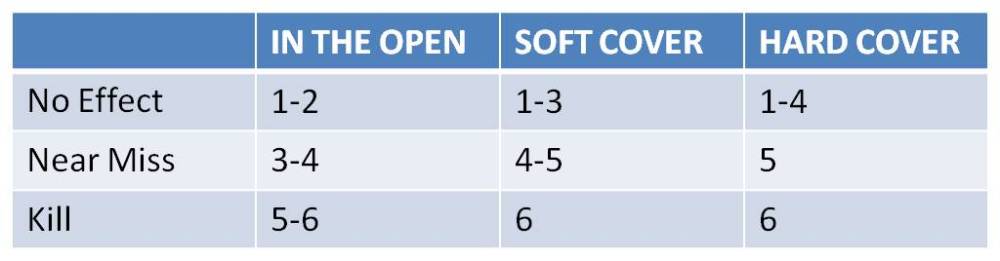
So you can see the type of cover, the effect of the shot and the dice rolls needed to achieve those effects.
Charging is when a figure moves into base to base contact with another, a bout of melee is immediately fought as the same action.
Melee combat is resolved simply too. Pair off combatants, and roll a die for each combatant. High roller kills their opponent. In the case of a draw, both are killed. Mounted figures get a +1 to their roll when fighting figures on foot. Figures that have not yet rallied from a ‘near miss’ result (see below) when engaged in combat receive a -1 modifier to their roll.
A reload action must be performed between each shot of a figures musket. All figures begin the game with their muskets loaded. When a figure fires place a counter next to them to show that their musket is unloaded, remove it once they have reloaded.
When a figure is fired upon and receives a ‘near miss’ result lie the figure on its side. That figure can perform no other actions until they have performed a rally action, and get back on their feet. Roll a die for each figure performing the rally action, on a 4+ the figure stands back up, on a 1-3 the figure stays down.
When either side takes a casualty during a player’s turn, at the end of that turn roll to see if that side’s morale breaks. Roll a die and multiply it by the number of figures on that side still in play, roll another and multiply it by the number of casualties they have taken. If the roll for casualties scores higher the side breaks and the game ends (this part of the rules is shamelessly stolen from Donald Featherstone). If both sides break on the same turn the game is a draw.
So those are my rules. Hopefully they’ll lead to some fun musket skirmishing!
‘

 Deathzap