Here’s a little bit of fun I think has legs!

While I don’t have much if any suitable terrain for 15mm figures a stripped down Darkfell board will suffice for some play testing.
Here’s a little look at my current thinking on how a sci-fi, or other game could be played.
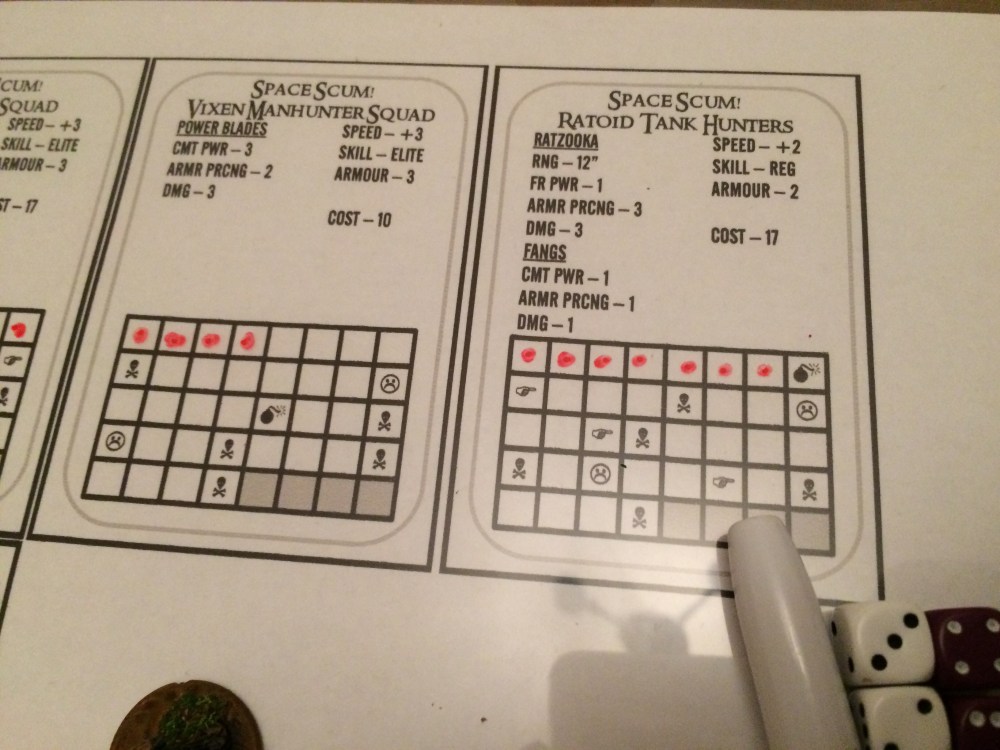
Each unit has a card, here I’ve printed each force off on A4 and slipped them into a plastic wallet. Doing this means I can mark off hits and make notes with a whiteboard marker that can later be wiped off.
The grid below the stats of the unit is a grid, when a unit takes a hit you mark a square off on the grid. You mark squares off on a row from left to right and once a row is fully marked off you move to the row below. Some squares are empty others contain symbols. A skull and crossbones means the unit takes a casualty, a finger pointing means the unit is pushed back 3″, a frowning face means the unit becomes suppressed and a bomb means the unit immediately returns fire or attacks back in melee combat.

The game played out incredibly quickly and my grid system means units can have a good amount of personality built in without the need for huge numbers of special and unique rules.
It’s going to take some tweaking, but I should get there soon enough.

 Deathzap
Interesting mechanic, so I’ve got to ask … the different arrangements of symbols in the grid mean that units react differently as they take hits. For example, the Ratoid Tank Hunters will retreat on occasion whereas the Vixens never retreat, so maybe this represents the Vixens being tougher? But do the slightly different placements of casualty, suppression and counter-attack symbols have any significance?
Yeah, you’ve got it. The Vixen Manhunters never fallback, which also helps them being a melee only unit. I’ve thought about adding another symbol for them meaning they actually advance when they’ve taken hits. The other force I played (Orts) had no fallback symbols army wide made it much easier to have them hold objectives. Hope that helps?