I guess this counts as another post on the importance of never throwing anything away. I’ve recently been playing Warhammer 40,000 which to be honest is a bit of a childhood dream come true. I’ve got pretty shaky hands, which doesn’t just affect my ability to paint figures sometimes it also makes it almost impossible for me to play games against the random opponent you might find in a Games Workshop. Having a tremor can be embarrassing, which in turn makes you focus on the fact that your hands are shaking, which in turn makes the tremor worse and quickly you find yourself in a feedback loop and completely unable to hold anything steady. As you can imagine this makes precisely moving small toys very difficult. Now that I have two close friends that are willing to play 40k and are both aware of my tremor I still shake, but I don’t get that feedback loop, because I know they’re expecting a tremor. The other downside to the tremor is that as I’m told chances are it will get worse as I age. So while I don’t find painting too difficult (other than edge highlighting) eventually it will probably be near impossible for me to paint figures in my current style.

I think this must be one of the reasons why I find the blanchitsu style so appealing, it frees you up from worrying about painting to a specific standard and allows you to approach figures more as an artist. It’s not a wargaming army you’re looking to make it’s an expressionist art installation.
Fancy talk aside, I wanted to make a small Death Guard force comprising mostly of Pox Walkers (or zombies to the uninitiated). Not only did I want to pull them from my bits box and make something truly strange I also wanted to approach them in a way painting wise that did not require much if any fine motor skill.
Below you can see my efforts before priming. They’re a mish-mash of parts but have all the Pox Walker essentials: claws or a hand weapon and they’re on a 25mm base. The sandy coloured stuff is a texture paste I make from sand, pva, filler, no more nails and paint. It’s there to strengthen weak joints add texture and interest to flat areas, and fill gaps.
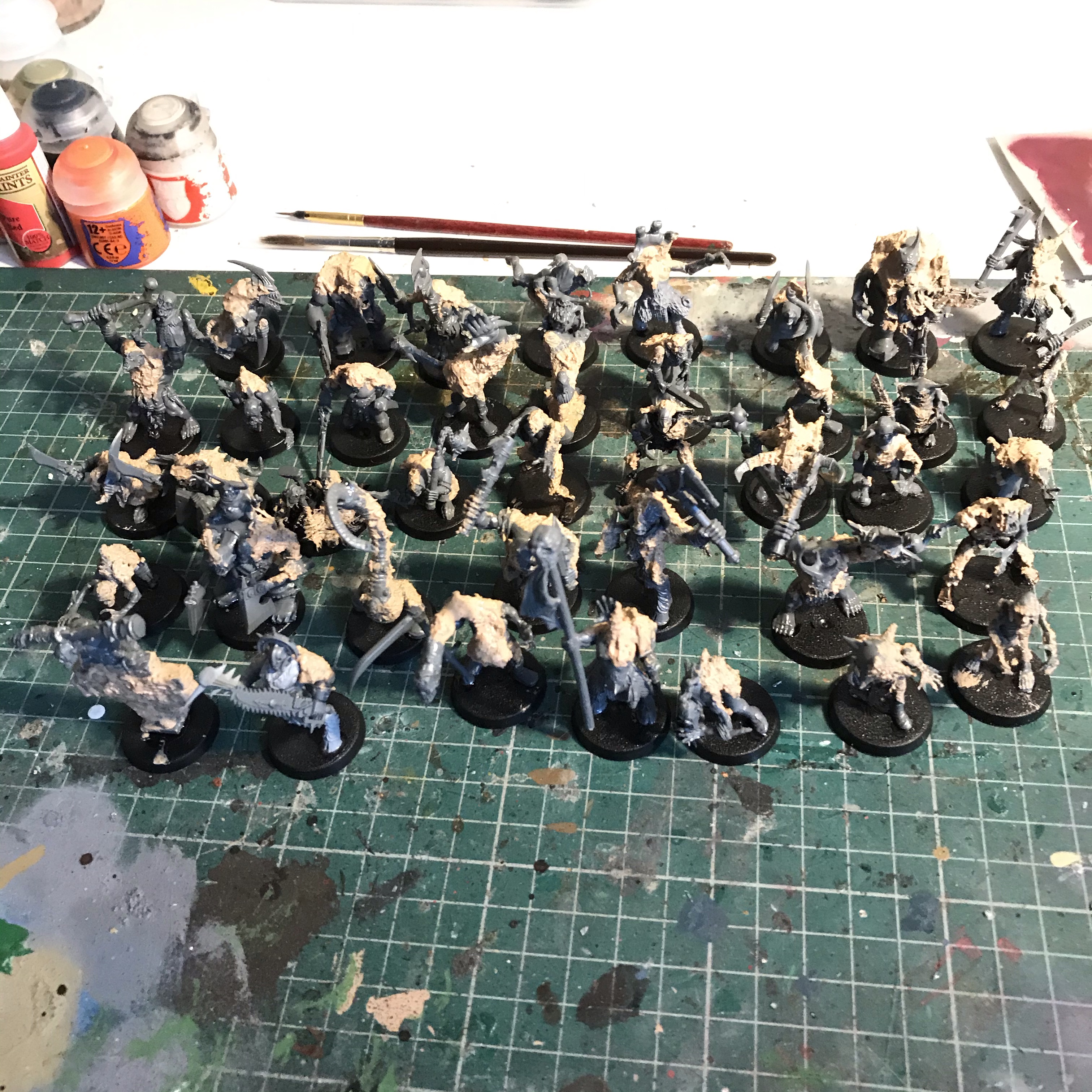
Before priming I also put sand on the bases and glued static grass and lichen. I knew the static grass would work, I wasn’t so sure about the lichen but I felt the freedom to try anything on these figures. Don’t be afraid to experiment from time to time, you might discover something that can transform your hobby!

After priming I did some garish base coating. The base coats went on with very wet paint and a very big brush. They needed to be garish because the steps I had already planned would have destroyed any subtler colours. I was also flicking reds and whites on the figures with a toothbrush. This was an experimental technique to apply more texture to the figures that completely worked, made cloth look more realistic and is a technique that I will definitely be bringing into my normal painting. Jackson Pollock would be proud.

If I remember correctly I then sprayed all the models again lightly from above with that same grey primer. This was an attempt to get highlights without having to do brushwork.
Because I wasn’t sure about the lichen I didn’t want to do too much brush work, also in the interest of speed I didn’t want to have to apply washes by hand. The wife had a solution for me a little spritz bottle that formerly had a product in that women understand but men don’t. I wasn’t going to be spritzing any GW washes however that would be far too expensive so in the end I settled on mixing water and acrylic ink.


The only real fine motor skills part of the paint job was next, I did some very basic highlighting with an off white/bone colour. I then applied appropriately coloured GW washes to areas to add colour and tone down any harsh highlights. I then dotted the eyes with a green watercolour paint. I also applied rust effects where appropriate with an orange-brown colour in watercolour ( watercolours are just like cheap and easy to use pigment powders). Watercolours are absolutely fantastic for this job and so forgiving since water reactivates the paint and allows you to remove any mistakes with basically no effort.

I then did the bases with that same rust colour and once dry edged them with black. It’s amazing how much work a black base edge does, the model transforms from something messy to a finished product in a single quick step!
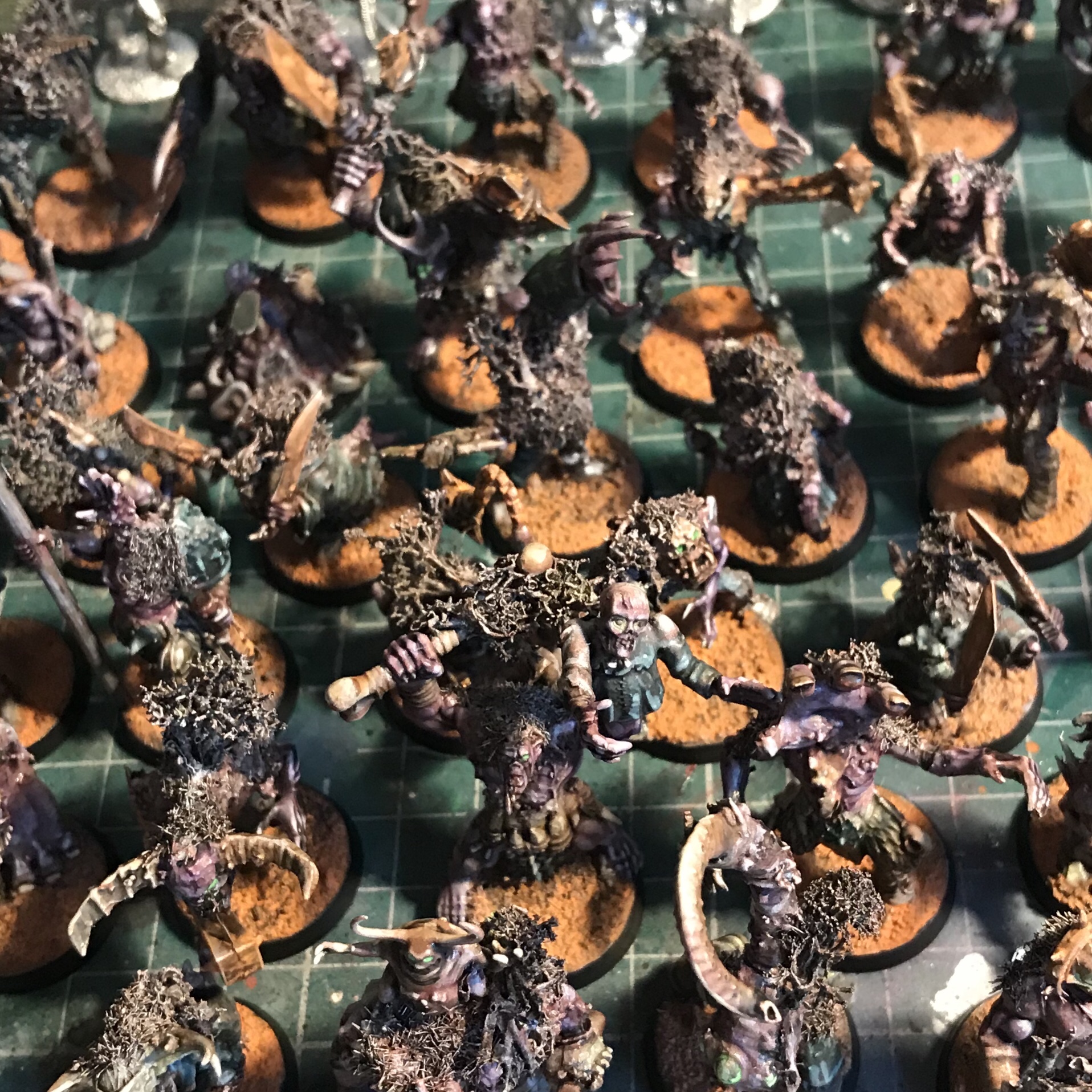
Because of the watercolours you have to spray varnish the figures or sweaty hands might remove your paint job, also it means you can play 40k in the bath. All in all I’m extremely happy with how my guys have come out and even while writing this I’m working my way through applying watered down PVA to the lichen to add much needed strength (I don’t know why I didn’t do this before). I might even apply some neat PVA to the ends of the branches and put them into some flock so they have leaves on their trees as if they’ve just emerged from Nurgle’s garden. I wanted to create a sense of a wall of horrible things coming towards you, and I think I’ve achieved that!

Including these guys I’m now up to 1052 figures painted this year which is frankly insane, and 900 bought (also insane).

 Deathzap
Fantastic work mate! Really enjoy our games as well 🙂
Thanks! Need to write up our batrep!
Wow, impressive stuff. How long does it take you to do all of this? Looking forward to your next post on wargaming in the bath (no pictures please)…
Working an hour or two a day for a week and I got all 40 done.
This was on Annie Norman’s Bad Squiddo Facebook channel and there are several more YouTube posts on this subject – https://youtu.be/oqp76vAJu9g
Thanks! I’ll check those out! I was recently watching Terrainosaur on YouTube who also had lots of advice.
Oh ha ha! Same thing!
Those look great.
Cheers,
Pete.