I think it’s important to know with a project when you’re done. Sometimes a painting is finished before you choose to stop, and the paint you added after that point only served to make things worse. The same goes for miniature painting. Films and books can sometimes be over-written, too clever, too well structured that they lose the chaos and abnormalities of reality. Maybe the same is true for wargame rules?
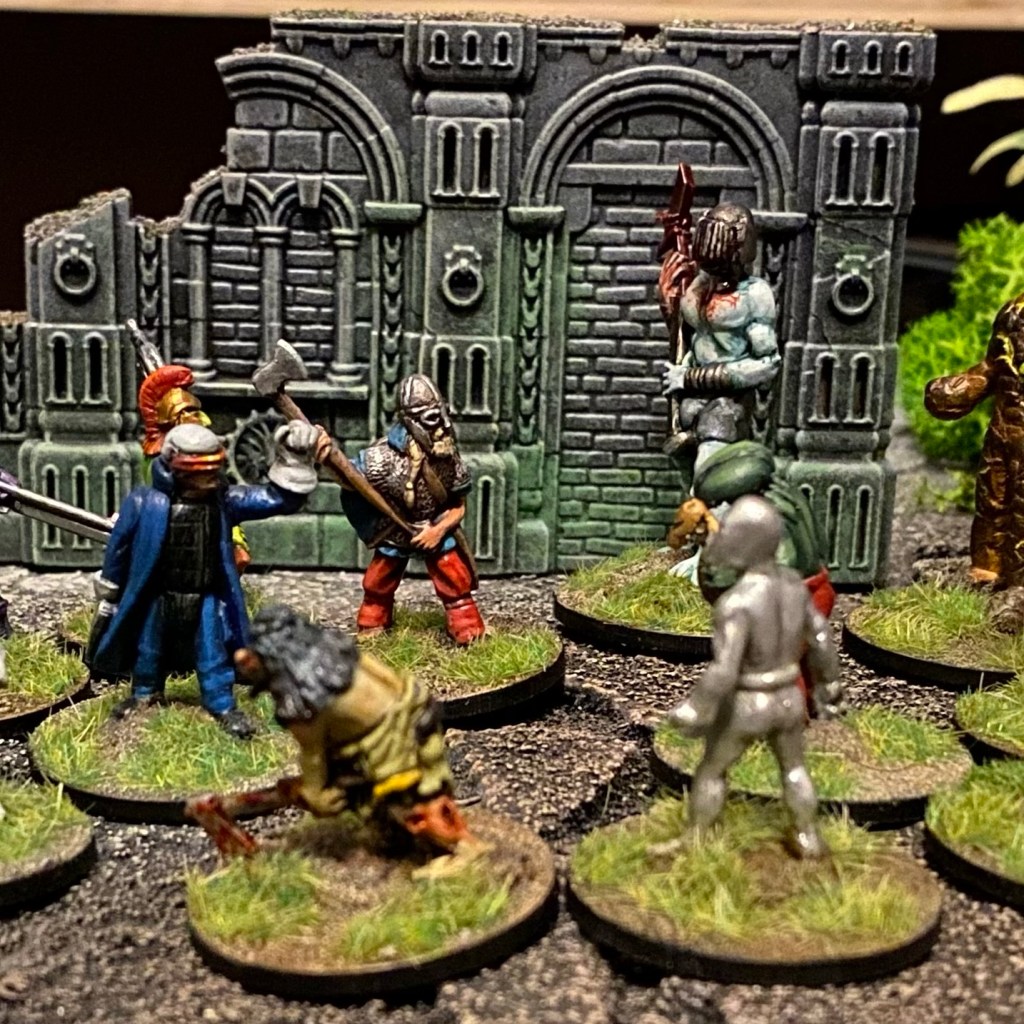
SKIRMASH has gone through several iterations since my original post (would you expect any less on this blog?). The game has been written and rewritten, mechanics employed and abandoned after a few games. At one point the entire game was card driven, at one point I got up to 5 stats, special rules and weapons with their own profiles. At its most complicated however, I felt SKIRMASH had lost its core.
This is the core by the way:

A simple game for pitting pretty much anything against anything else.
The only real problem’ I found with that core was the D20 roll to determine the order figures activate in. With larger games it took a while (almost as long as the turn/round itself) to roll D20s, add the modifiers and place them next to the figures or note down on a piece of paper (when I didn’t want the board cluttered) when people were activating.
To address that slowness I’ve tried a simple Featherstonian – A moves, B shoots, B moves, A shoots, resolve melees, but it didn’t feel right for a skirmish game.
I’ve tried a simple alternate activation system, which was also fine, but lacked any innovation or imagination.
I also wanted to add ‘wounds’ as a stat, so figures can take more or less than the standard 3 before being killed. Thinking of a downside to having lots of wounds (since stats have to self balance) proved difficult, however. The Combat stat being the obvious split between being go good at ranged vs good at melee, the Manoeuvre stat being the obvious split between speed vs armour also makes sense. So what’s the split with wounds?

Anyway… here’s the current state of play, it’s just as quick, just as bloody and works better with slightly more figures (I like 5 a side). The ‘scenario’ as always needs work.
SET UP
The game is played on a 2’x2’ board. Players should have the same number of figures (from 3-10). Figures have three stats, ‘Manoeuvre’, ‘Combat’, and ‘Stamina’. Stats can be any value from 1-5.
THE GAME
The game is played over 4 rounds. At the start of a round players roll off to determine who activates a figure first. Players then alternate activating figures until all of one player’s figures are exhausted, then their opponent can activate each of their non-exhausted figures once more, and then the round ends.
The side that kills the most enemies wins.
ACTIVATING
When a figure is activated they can perform a number of actions. To determine how many roll 1 die per point of Manoeuvre the figure has.
A roll of 1-3 is a single action.
A roll of 4 or 5 is two actions.
A roll of 6 is three actions.
Once a figure has completed all of their actions they take a Stamina check, and then their activation is over.

MOVEMENT
For 1 action a figure can move 1”.
RANGED ATTACKS
A figure can spend actions to make a ranged attack. 1 action = 1 die. A figure can only make 1 ranged attack per activation against a single enemy (but can use multiple actions to get multiple dice).
To hit the target, roll each die trying to beat the attacking figure’s Combat stat.
+1 to the attackers Combat stat if the target has soft cover, +2 for hard. Natural 6’s always hit and natural 1’s always miss.
For each hit the target makes a saving throw, to do so they must roll above their Manoeuvre stat.
Each failed save results in a wound.
MELEE ATTACKS
If a figure is in base to base contact with an enemy at any point during their activation can make a melee attack against that enemy for free. They can only make one melee attack per activation.
Roll 1 die per point of Combat the attacker has. Each die that rolls above the target’s Combat stat causes a wound.
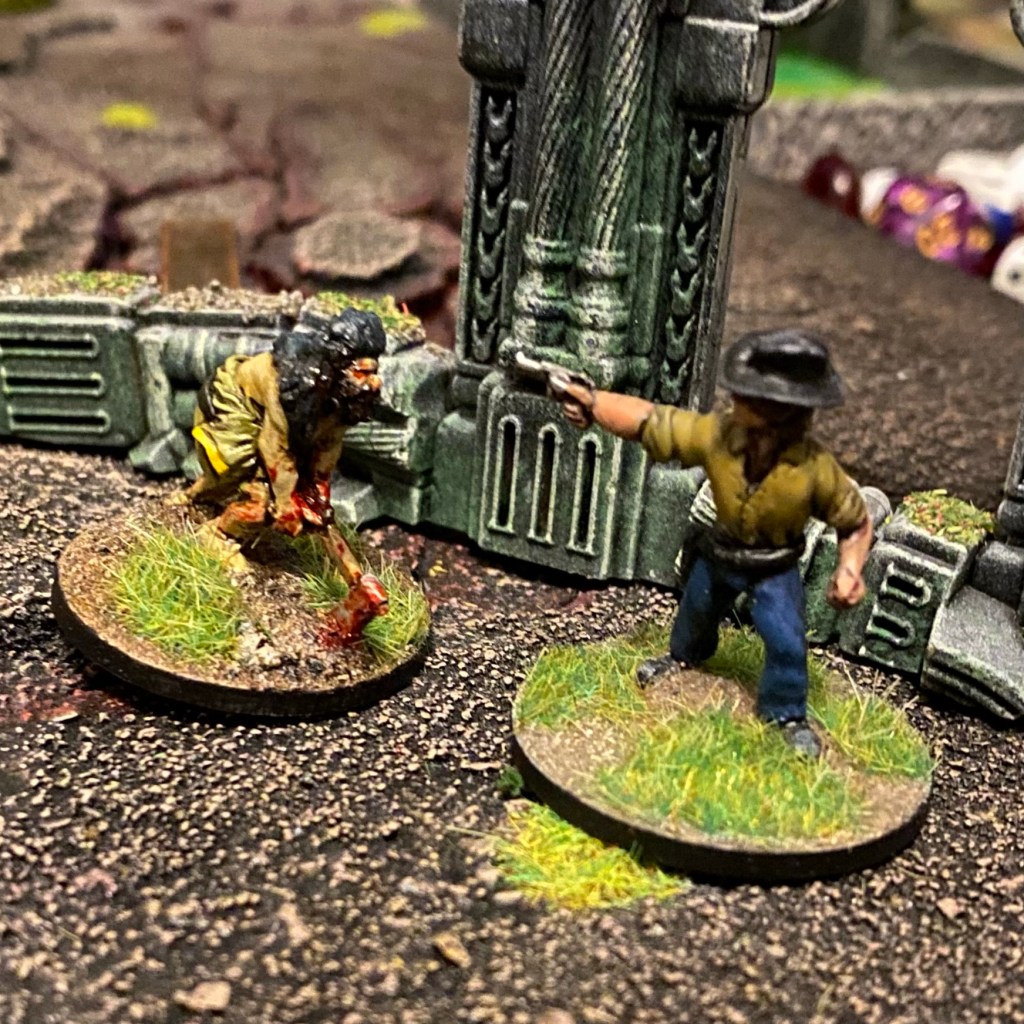
KILLING ENEMIES
Once a figure has suffered a number of wounds equal to their Stamina stat they are killed.
STAMINA CHECKS
When a figure has finished attacking they must take a Stamina check, roll a die. If the result is equal to or lower than their Stamina stat then they are exhausted and cannot be activated again this round.
If you give this newer version a go, let me know how it goes!

 Deathzap
Have you thought about the “random” activation of drawing a colored dice from a bad, like Bolt Action?
Yeah, although not strictly dice from a bag, I used cards from a deck for a while for the same purpose.
Quick test with soft plastic unpainted toystore 45mm indians and cowboys.
I wrote stats on each fig’s base with an erasable marker. Figs with only melee weapons had high combat and manoeuvre stat, the rest was randomly chosen.
I just added that each wound causes a -1 on your result for stamina check (hard to run with sooo much lead in your knee !).
Everything went pretty well. First round a lone cowboy managed to run across the map and shoot one opponent before failing his stamina check. It took two indians to bring him down. I realized that with good stamina checks you can kill every enemies during first round with one guy ! A 1/5/1 (combat/manoeuvre/stamina) or 5/5/1 is a good choice for first activation.
In the last round, the last indian managed to shoot the 2 remaining cowboys in 2 activations.
I think this game mixes well strategy with randomness. If I have more time I’ll test it with extreme stats.
That’s interesting. I found anyone with a stamina of 1 died way too quickly and easily, 2s seemed to be the worst, 3s and 4s seemed the best. It’s encouraging we got different results, seems things could be more balanced than I’d thought.
Today’s test (stats are combat/manoeuvre/stamina) :
5 vs 5
Team A : 3x(3/3/3), 2x(4/4/4)
Team B : 3x(5/5/1), 2x(1/5/1)
First (and last) round : Team A wins activation. One guy moves to a place with a good line of sight and fails his stamina check. Team B activates a 5/5/1 and tries to rush (9 actions) in the open but fails stamina check (oopsie). A moves a second guy to be able to shoot, pass stamina check, shoots 6 times at the enemy in sight and bring him down. Shooter is even able to go back to cover before failing stamina check.
B sends another 5/5/1. He gets closer, making good use of cover but fails his second stamina check.
A activates a guy on the other flank and makes him advance in cover but fails on first stamina check.
B activates last 5/5/1. Good activation with 12 actions. 5/5 rushes on the other flank and manage to get closer of A’s 4/4. Second activation gives 9 actions. 5/5 is still running and now 1 inch away from his enemy. Third activation : 5/5 tries to shoot with no success and engages in melee. 4/4 is hacked to pieces. Stamina check : still good ! 6 actions on fourth activation. 5/5 can run in enemy lines and is once again 1 inch away from an opponent. Fifth activation : 5/5 engages in melee but only causes 2 wounds and finally fails his stamina check. A activates guy who was in melee. He moves one inch back and shoots 5/5 down but fails his stamina check.
B activates a 1/5/1 and it goes similar as before, but with rushing, shooting and passing stamina checks to wipe out every enemies still standing.
That was brutal.
I used the one wound = -1 on your result for stamina check.
Maybe next time I’ll add this rule :
On first stamina check you test for your stat (applying eventual wounds), on the second you test for your stat +1, on the third your stat +2 and so on. Natural 6s always count as good.
I also thought of stats randomization : before deployement, roll 3 coloured D6 for each fig. One colour is one stat, on a 6 you choose your value.
Useful when you’re using little cardboard squares instead of figs, you can even write stats on them directly !
Brilliant work as always. Quick question, are you playing it where one figure can activate multiple times in succession if they pass stamina checks, without the other side activating in between? What I intended was a passed stamina check allows you to activate the same figure again later in the round, but not immediately, your opponent will always get an activation first. However I’m interested in trying it out the way you’ve been playing things if that is the case.
Seems like I misunderstood a little thing. I’m playing with multiple successive activation of the same fig as long as they succeed at stamina check, without activation for the other player inbetween. Rushing berserker combo mode.
The way you intended it is not exactly the same game.
Not so good foreign language understanding for me, but still funny playing time. Now I must try again !
No problem at all! Reading through the rules myself I now realise I communicated that rule poorly and I’ve reworded it to make things clearer. I’ll be interested to hear how you find that version.