So to make my former posts make a little more sense and before expanding things outwards, here’s what we’re working with in regards to Havok, with a few sensible adjustments from me:
COMBAT DATA
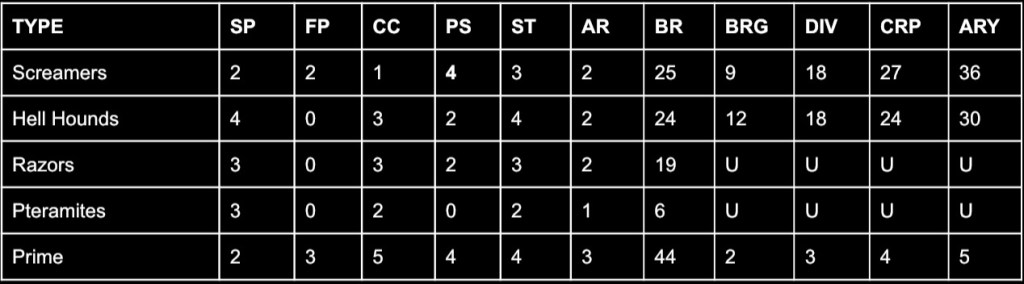
SPEED – Generally lighter armed warriors will be able to move faster than more heavily armed warriors. However, physical size can have an impact on the speed with which warriors can move.
FIREPOWER – This indicates the power of the warrior’s weapons, and takes into account their skill in using them.
CLOSE COMBAT – This indicates how effective the warriors are at fighting in hand-to-hand combat.
PSYKE – Strength of mind and psychic powers are indicated by a warrior’s psyke value. Some warrior’s are able to attack their opponents using psyke. These are powerful mind attacks and can be devastating even to seasoned veterans.
STRENGTH – This is a measure of the warrior’s physical strength, as well as their ability to endure damage and hardships.
ARMOUR – The higher the armour value the more likely a warrior will be able to survive a shot or blow that would otherwise kill. Higher armour values represent better armour being worn or warriors that are just naturally tough.
BATTLE RATING – This is a value which allows players to judge the relative combat effectiveness of different warriors.
SPECIAL ABILITIES
Some warriors have special abilities the rules of which are fully explained in the Army Lists below.

CHOOSING A FORCE
Before the game players agree on how many points they will spend in organising their force. This is done using Battle Ratings.
ORGANISATION AND BATTLEFIELD SIZE
Depending on the size of his force, there is a limit to the number of warriors, for a given troop type, that a player can include in his force. This is shown on the miniatures battle card, for sioe warriors there is no limit, in which case a U is shown. The size of a force depends upon the total number of points players have agreed to use:
Number of Points – Force Size – Battlefield Size
0-500 – Brigade – 4’x4’
501-1000 – Division – 4’x4’
1001-1500 – Corps – 6’x4’
1501+ – Army – 6’x4’
It is recommended that at different game sizes the area you play on is big enough to fit all of the forces comfortably.
LAYING OUT THE BATTLEFIELD
For a battle players should use a number of terrain pieces such as hills, woods and buildings. Roughly divide up the available terrain between players, and then in turn each player places one piece of terrain until all pieces have been placed.
DEPLOYING YOUR ARMY
First player’s roll off and the higher roller picks a battlefield edge to be their starting edge. Their opponent automatically takes the opposite edge, then:
- Any player that has warriors that have not yet deployed rolls a die.
- The player with the highest score chooses one of their Warrior types.
- All warriors of that type are deployed on the battlefield within 12” of their player’s starting edge. For example if a Nexus player chooses to deploy their Nexus Troopers, then all Nexus Troopers are deployed.
- If either player has warriors that have not yet deployed, players roll again.
- Once one player has deployed all of their warriors, their opponent deploys all remaining warriors.
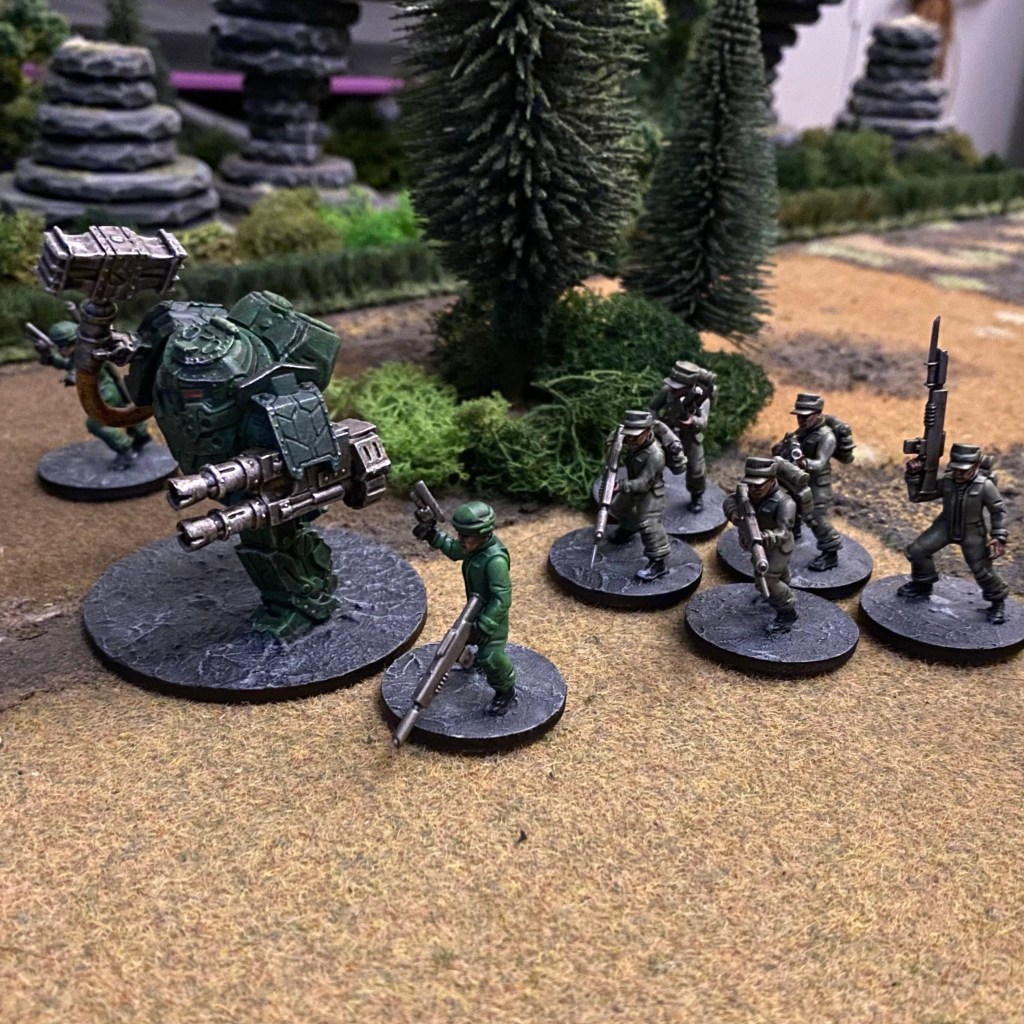
SEQUENCE OF PLAY
The game is played in a series of Battle Turns. At the end of the fourth Battle Turn the game ends and a victor is declared.
THE BATTLE TURN
Each Battle Turn consists of a number of Combat Rounds.
PLAYING A COMBAT ROUND
- Any player that has warriors that have not yet activated yet in this Battle Turn rolls a die.
- The player with the highest score chooses one of their Warrior types.
- All warriors of that type may move and then either fire their weapons or make a melee attack. For example if a Nexus player chooses their Nexus Troopers to activate, all Nexus Troopers then activate.
- Once all the warriors of that type have activated the Combat Round is over and that warrior type cannot be activated again during this Battle Turn.
- If either player has warriors that have not yet activated this Battle Turn play another Combat Round otherwise the Battle Turn is over and a new Battle Turn begins.
MOVING
A warrior’s speed is shown in their Combat Data. This indicates the distance a warrior may be moved in 6” increments. For example a warrior with speed 2 can be moved up to 12”. A warrior may move less than the maximum distance allowed if desired. When moving a warrior may not:
- Move directly through enemy warriors or items of terrain that logically they could not move through.
- Split their movement before and after attacking.
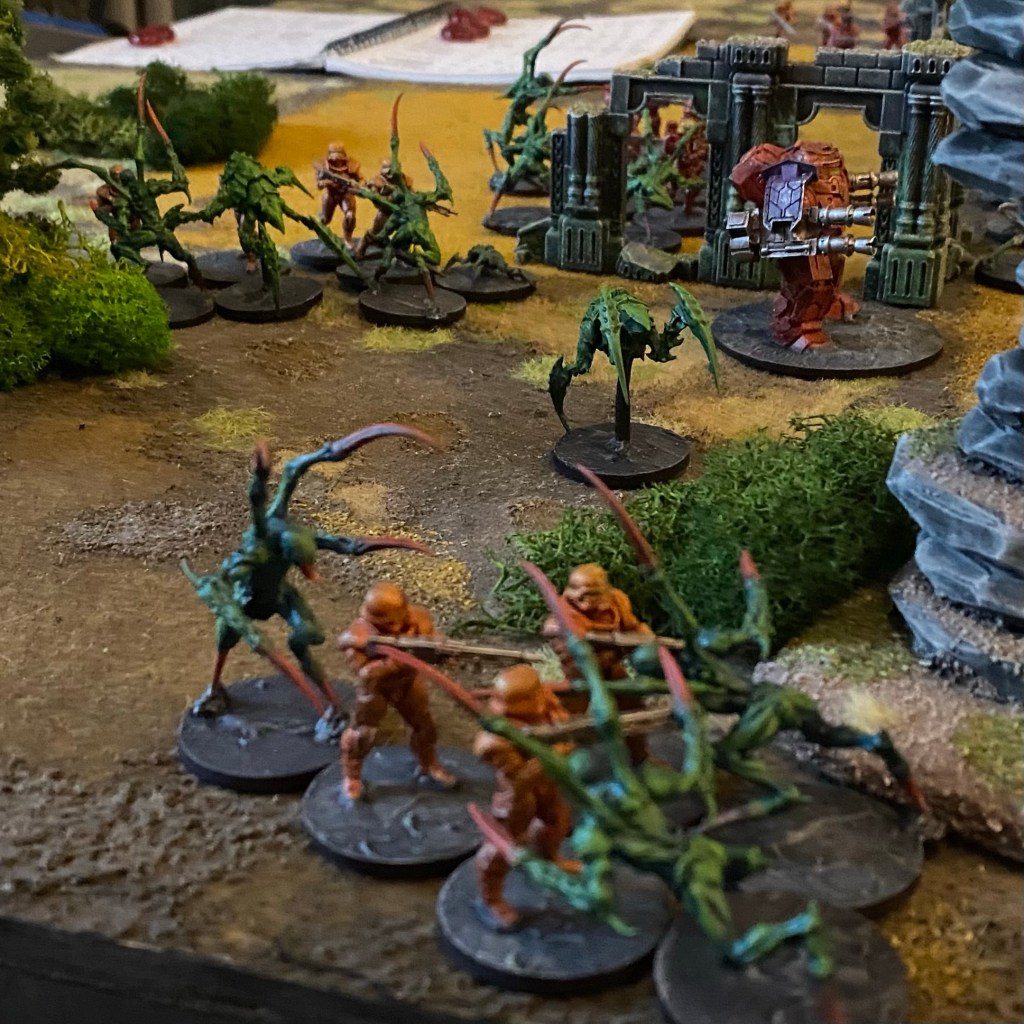
FIRING
When firing you must first nominate which warrior is firing and their target. This may be; an individual warrior, a unit of warriors or a single vehicle. Warriors may not target enemy warriors in base contact with allies. Having nominated the target roll a number of dice indicated by the firing warrior’s Firepower value.
UNITS FIRING
A unit of warriors may concentrate their fire. This allows the player to roll all the dice at the same time, for those warriors firing together. Therefore, a unit of three warriors, with a firepower of 2, would roll 6 dice if they fired as a unit. A unit may split its fire between two or more targets.
SHOTS ON TARGET
The number of shots on target is determined by the range to the target and any cover the target may have:
At 0-6” 2s-6s hit. If the target is in cover 3s-6s hit.
At 6-12” 4s-6s hit. If the target is in cover 5s+6s hit.
At 12-24” 5s-6s hit. If the target is in cover 6s hit.
At 24”+ 6s hit if the target is in the open, or in cover.
Each 6 rolled allows one extra die to be rolled. If this die is also a 6 another die may also be rolled, and so on, until a 1-5 is rolled.
CLOSE RANGE
Any warrior firing at a target that is within 6” will score a hit on a 2 or higher and only 1s count as misses.
BEATING ARMOUR
Total up the number of shots on target. Then roll that number of dice again, this time attempting to roll higher than the armour of the target. Each hit that beats the armour of the target causes a wound.
WOUNDS
Each warrior can suffer a number of wounds equal to their Strength value before being killed. If a warrior is not completely killed mark them with a die showing their remaining wounds. If a unit suffers wounds all wounds are dealt to a single warrior until they are killed, then all wounds will be dealt to another single warrior, and so on until the unit is wiped out.
DESTROYED VEHICLES
If a vehicle is ever destroyed, remove it from the game. Any warrior that was on top of, in base contact with, or inside the vehicle when it was destroyed, suffers a hit and must make a saving throw.
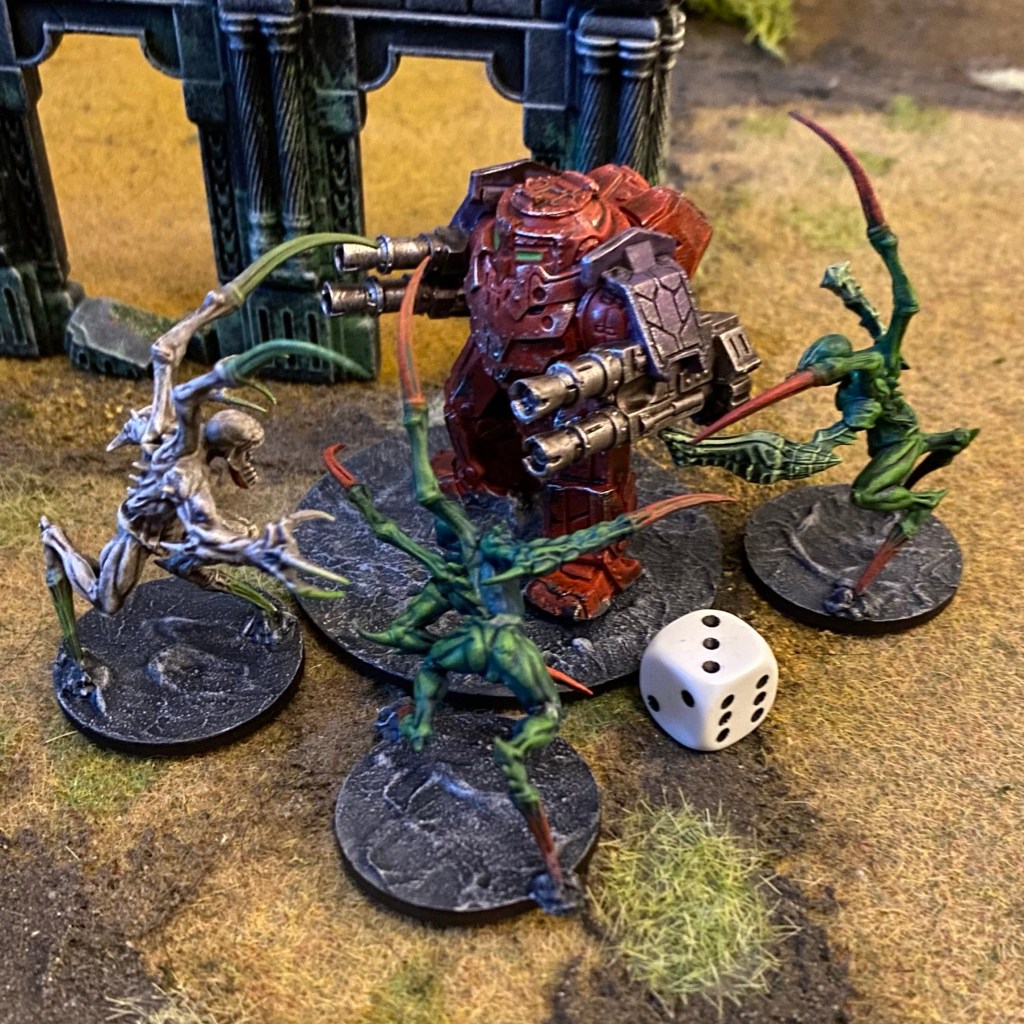
CLOSE COMBAT
Close combat is when two warriors engage in hand to hand combat. Close combat is only ever fought between two warriors at a time. Close combat may only be fought if an attacking miniature is in base to base contact with an enemy warrior. A player may attack a single enemy warrior in close combat with more than one of his warriors. Alternatively, a single warrior may be moved so as to attack more than one enemy. In either of these cases each combat should be fought one after another.
RESOLVING CLOSE COMBAT
Both players roll a number of dice equal to the close combat value shown on their warrior’s combat data. A warrior also may gain a strength bonus, if their warrior has a higher strength stat than their opponent, then they gain 1 extra die per additional point of strength. A warrior scores hits on a 4,5 or 6, and as with shooting 6s allow extra dice to be rolled. A warrior also blocks one of their opponents hits with each 6 rolled.
Each warrior must make saving throws for each hit their opponent scored, and they suffer wounds as in shooting.
For example: A Nexus Hundred Battle Form fights a Pteravore Razor. The Battle Form has a close combat value of 3 and a strength of 6. A Razor has a close combat value of 3 and a strength of 3.
The Battle Form rolls 6 dice, as it has a close combat of 3 and a strength bonus of 3.
The Razor rolls 3 dice, as it has a close combat of 3, and doesn’t gain a strength bonus against the Battle Form.
The Battle Form rolls 1,2,2,4,6,6. The Battle Form gets 2 additional dice and rolls a 3 and a 5. The Battle Form scores 4 total hits.
The Razor rolls 2,3 and 5. The Razor would score 1 total hit, however the hit is blocked by the Battle Form’s roll of 1.
MULTIPLE OPPONENTS
When a warrior fights multiple opponents if they would have a strength bonus, that bonus is reduced by 1 for each opponent after their first.
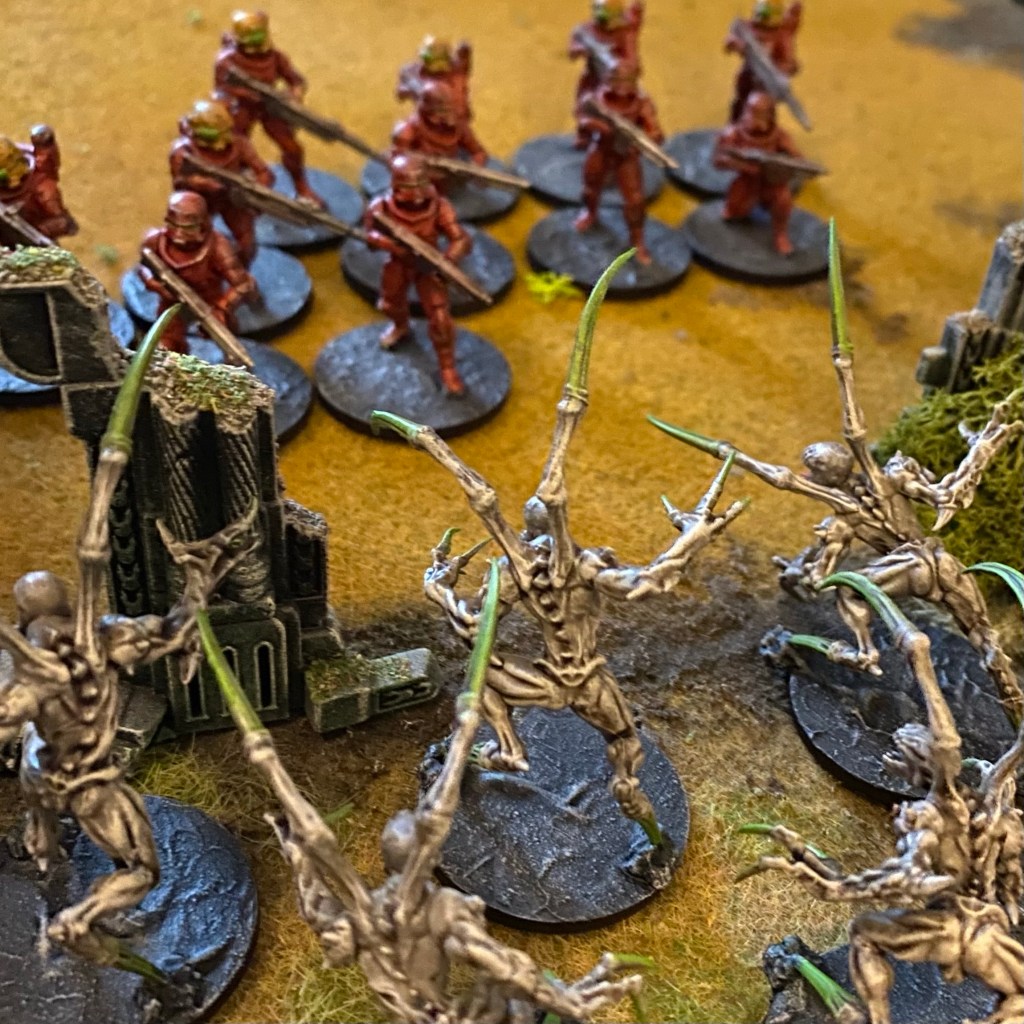
PSYKE ATTACKS
Some warriors are able to attack using their telepathic skills. Warriors that are able to attack this way have a Psyke value shown in bold on their combat data. Psyke attacks are only ever resolved between two opposing warriors at a time, units may not combine to make a more powerful attack. A miniature may only attack other warriors with a psyke attack if they are within 6”. A warrior does not need to see an enemy in order to make a psyke attack against them.
Both players roll a number of dice equal to the psyke value shown on their warrior’s combat data. A warrior scores hits on a 4,5 or 6, and as with shooting 6s allow extra dice to be rolled. A warrior also blocks one of their opponents hits with each 6 rolled.
Each warrior must make saving throws for each hit their opponent scored, warriors only save on a roll of 1, and they suffer wounds as in shooting.
WINNING THE BATTLE
At the end of the 4th Battle Turn the game ends. Total the Battle Ratings of all casualties on each side. The winner is the player that caused the highest total loss to their opponent.
ARMY LISTS
The following lists record all the combat data for each warrior type, any special rules and the number limits in Brigade, Division, Corps and Army level games.
THE KARN EMPIRE

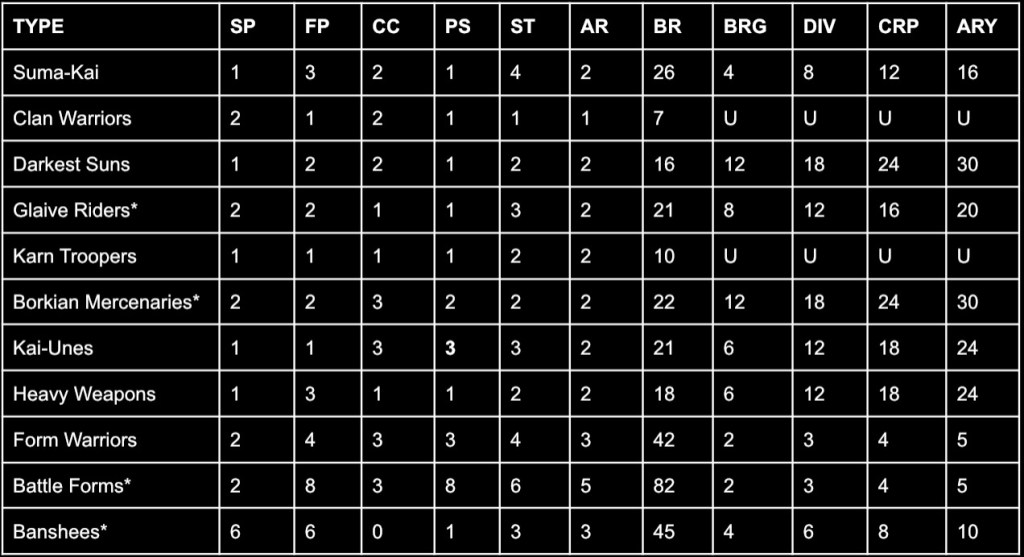
Borkian Mercenaries – Once per game all Borkian Mercenaries in play may be moved at speed 4.
Glaive Riders – A Glavie Rider may move over any warriors or obstacles on the battlefield. When a Glaive Rider is killed they explode in the same way that a vehicle does.
Battle Forms – A Battle Form is a vehicle.
Banshees – A Banshee is a vehicle. A Banshee may split its move before and after combat. A Banshee may move over any warriors or obstacles on the battlefield. A Banshee can never be engaged in close combat.
THE NEXUS REBELLION
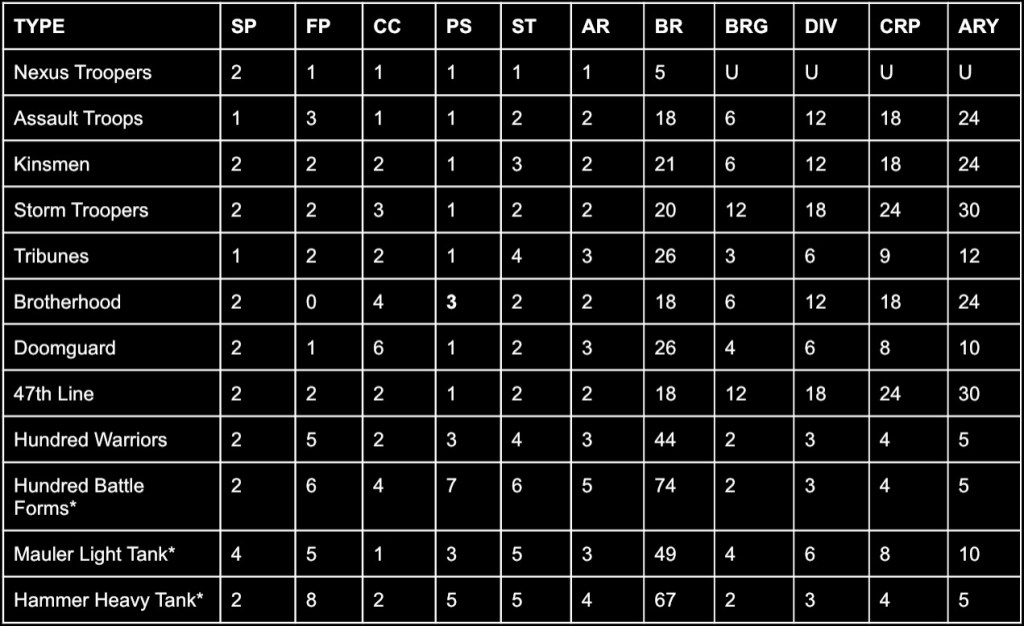
Hundred Battle Forms – A Hundred Battle Form is a vehicle.
Mauler – A Mauler is a vehicle. A Mauler may split its move before and after combat. A Mauler may carry one warrior. The warrior may move and fight as normal from the Mauler when its type is activated.
Hammer – A Hammer is a vehicle. A Hammer may split its move before and after combat. A Hammer may carry up to 6 warriors. A Hammer can only carry Nexus Troopers, 47th Line or Storm Troopers. Warriors inside the Hammer may not be fired at, although may be psyke attacked. Warriors inside the Hammer may move and fight as normal from the Hammer when their type is activated, measuring their movement from the rear doors. Up to six warriors may shoot out of the Hammer while they are inside it.
THE PTERAVORE

 Deathzap
Very comprehensive-your rules are proliferating- maybe you need to publish an almanac of your rulesets and their evolution 😀