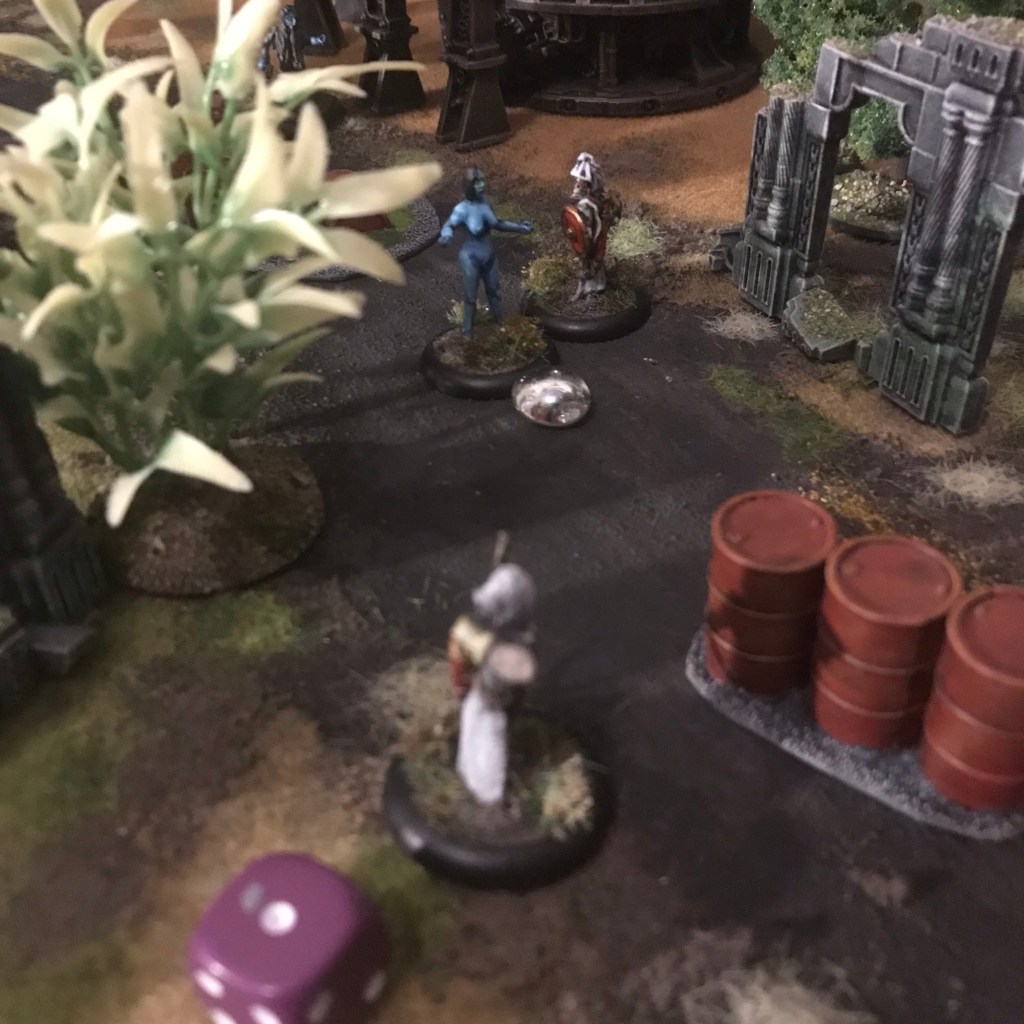
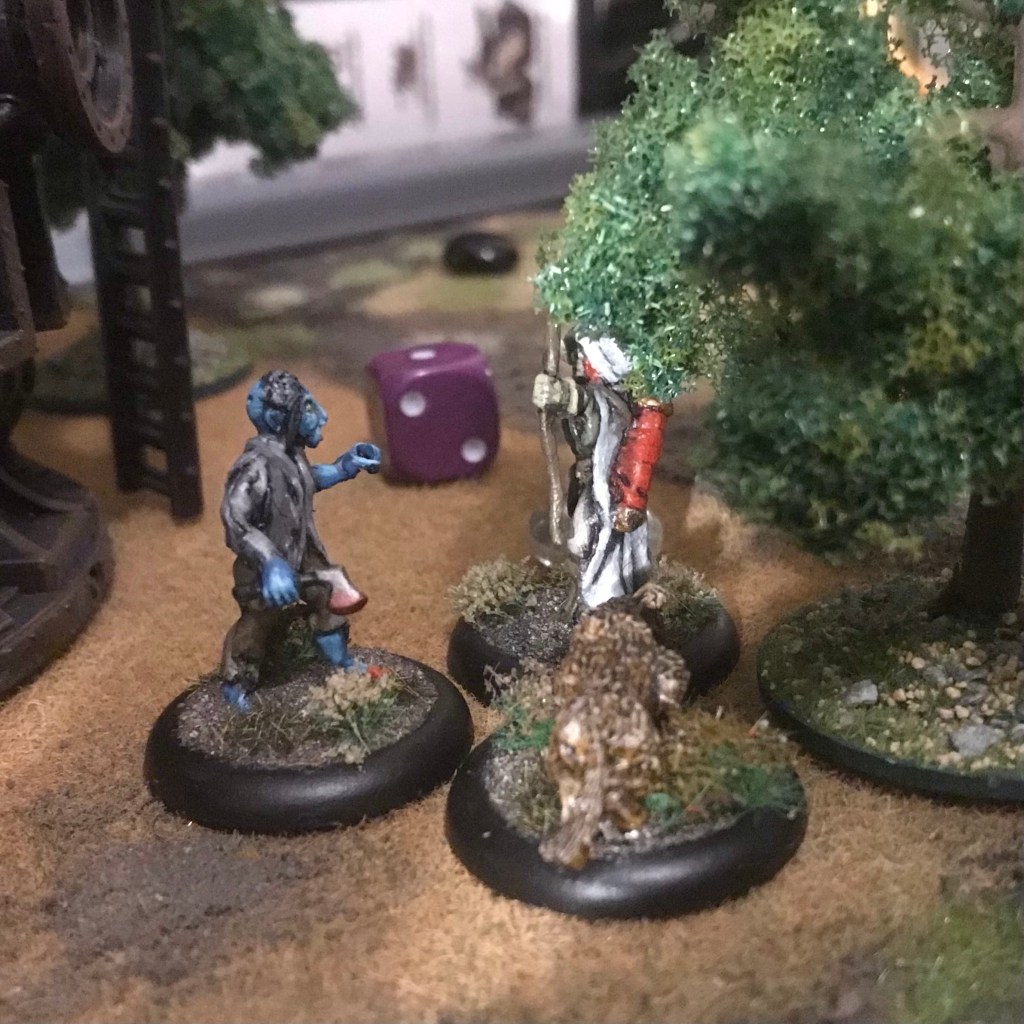
Sometimes revisiting older versions of your own rules is a lot of fun, almost like playing a game written by someone else. This time round I took an early version of my simple skirmish rules for a spin, putting my Zombie Family against the Windblade Elves.
The rules are as follows:
WARBANDS, FIGHTERS AND STATS
Players gather a warband each, each warband is made up of fighters. Fighters have a class and one stat: Might. An example stat line is as follows:
| Name | Class | Might |
| Hunter | Soldier | 10 |
There are 10 available classes
Common Classes – Soldier, Warrior, Beast, Drone.
Special Classes – Gunner, Berserker, Sniper, Gunslinger.
Rare Classes – Monster, Mech.


THE GAME BOARD AND DEPLOYMENT
Games are played on a 24”x24” board. Deployment zones are 6” when playing side to side, and 11” corner to corner (measured from the corner in a quarter circle). Before the game begins roll a die to randomly determine deployment zones: 1-3 side to side, 4-6 Corner to Corner.
Five shrines are then placed, these are locations used to generate Fate tokens (see below). Place a single Shrine in the centre of the playing area. Player’s then place two shrines each anywhere on the board a shrine cannot be within 6” of another shrine.
Both players then roll a die, the higher roller can choose which of the deployment zones they would like, they then place all of their fighters in their deployment zone. The opposing player then places all of their fighters in the opposite deployment zone. The player that placed their fighters first takes the first turn in the game.
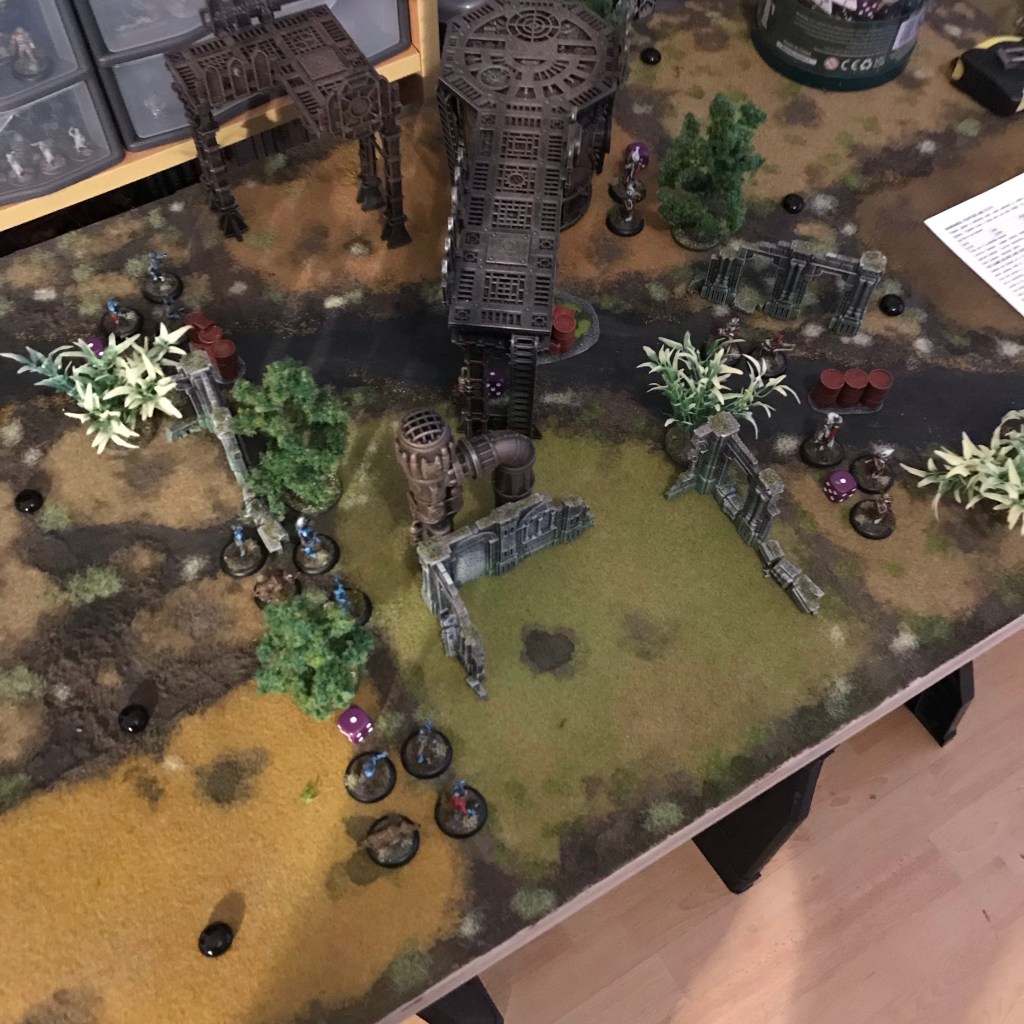
FATE
Before the game begins each player is given 10 Fate tokens. Those tokens can be used during the game to modify or reroll dice rolls and can be used to have fighters perform a second action in a turn. The second action can never be the same as the first action.
A player can only spend fate tokens on their own die rolls and each roll can only be rerolled and/or modified once. A rerolled result stands even if it is worse than the original roll. When rerolling all dice must be rerolled.
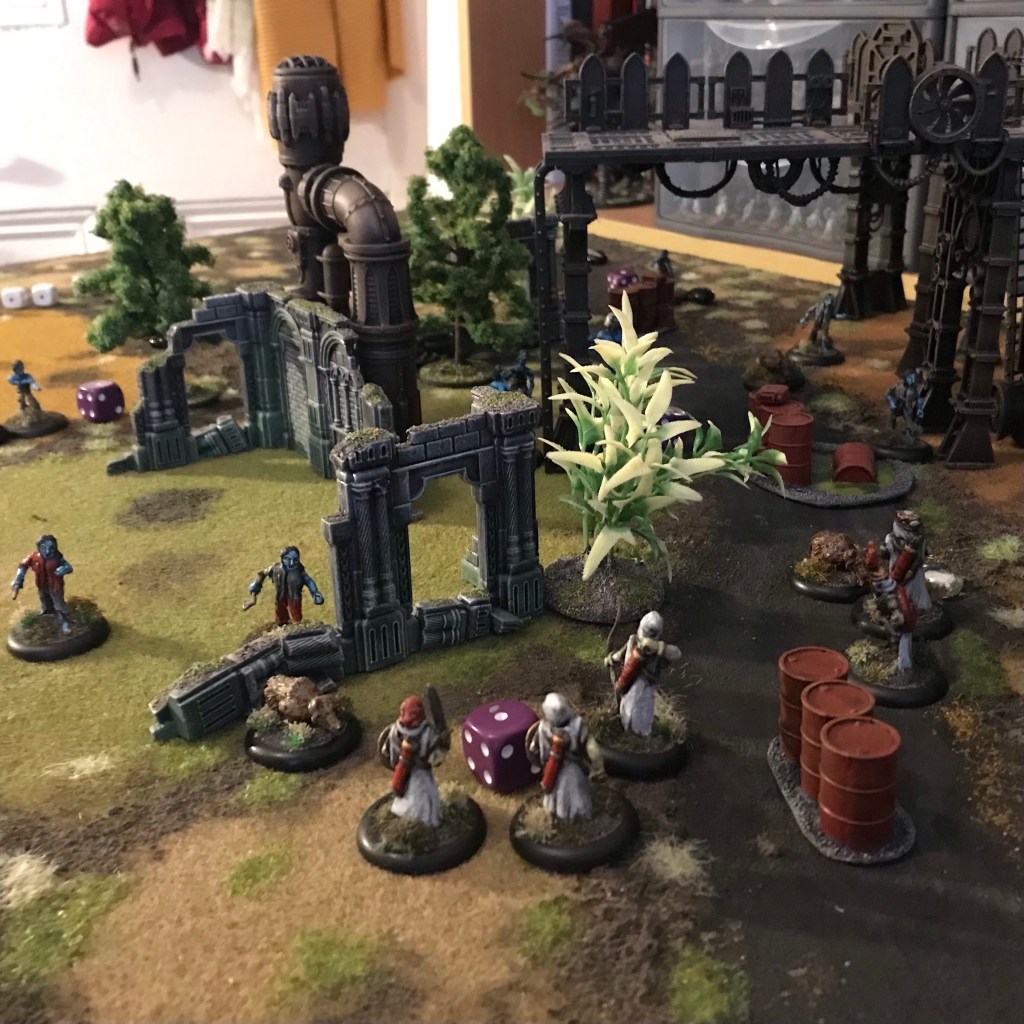
THE GAME
Players take turns. Each of a player’s turns breaks down into three phases – Restock, Activations and Morale. The phases always happen in that order. Only the player whose turn it is can activate fighters during their turn. During your Activations phase you can activate each of your fighters and have them perform one action. A fighter can either move, shoot or make a melee attack. Warriors, Beasts, Berserkers, Gunslingers and Monsters can charge, meaning they make a normal move and if they make it into base to base contact with an enemy can also make a melee attack in the same action.
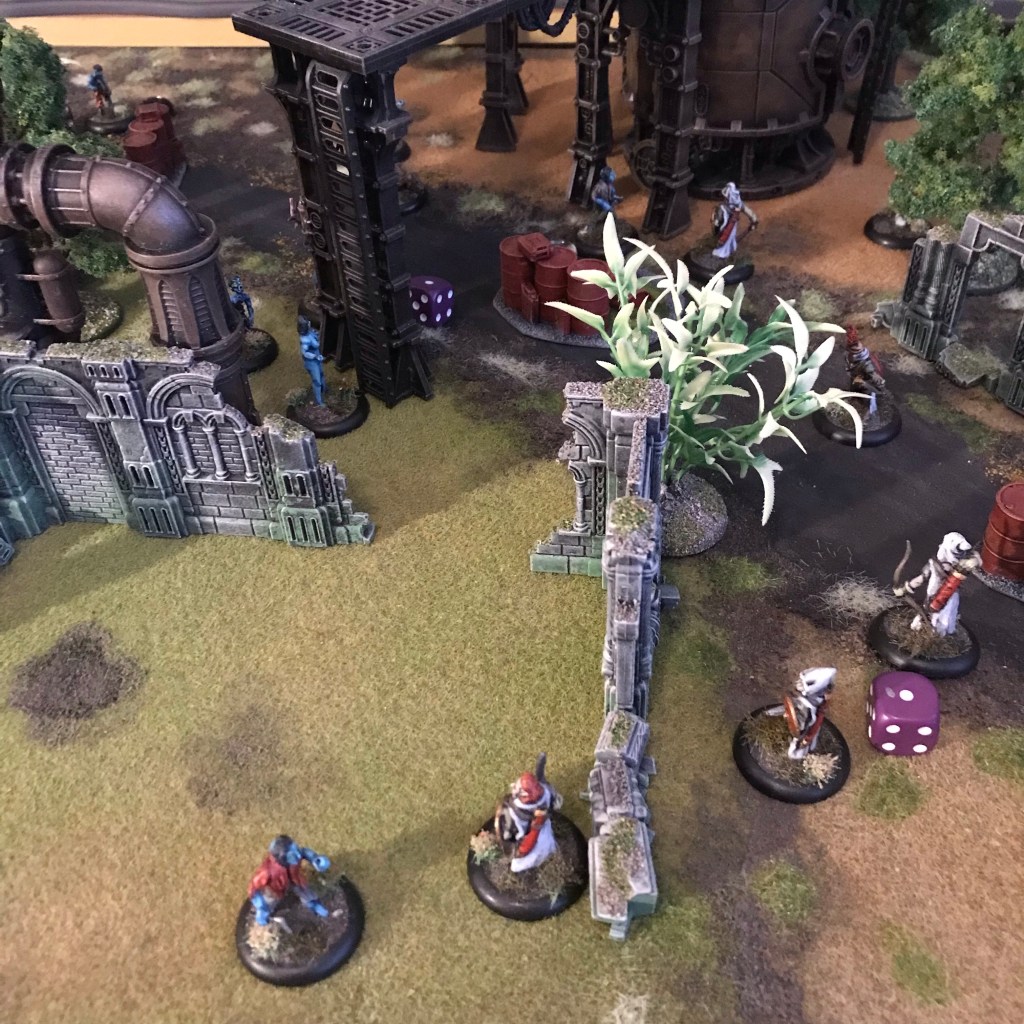
RESTOCK
The player whose turn it is gains 1 Fate token for each shrine within 3” of one of their fighters.
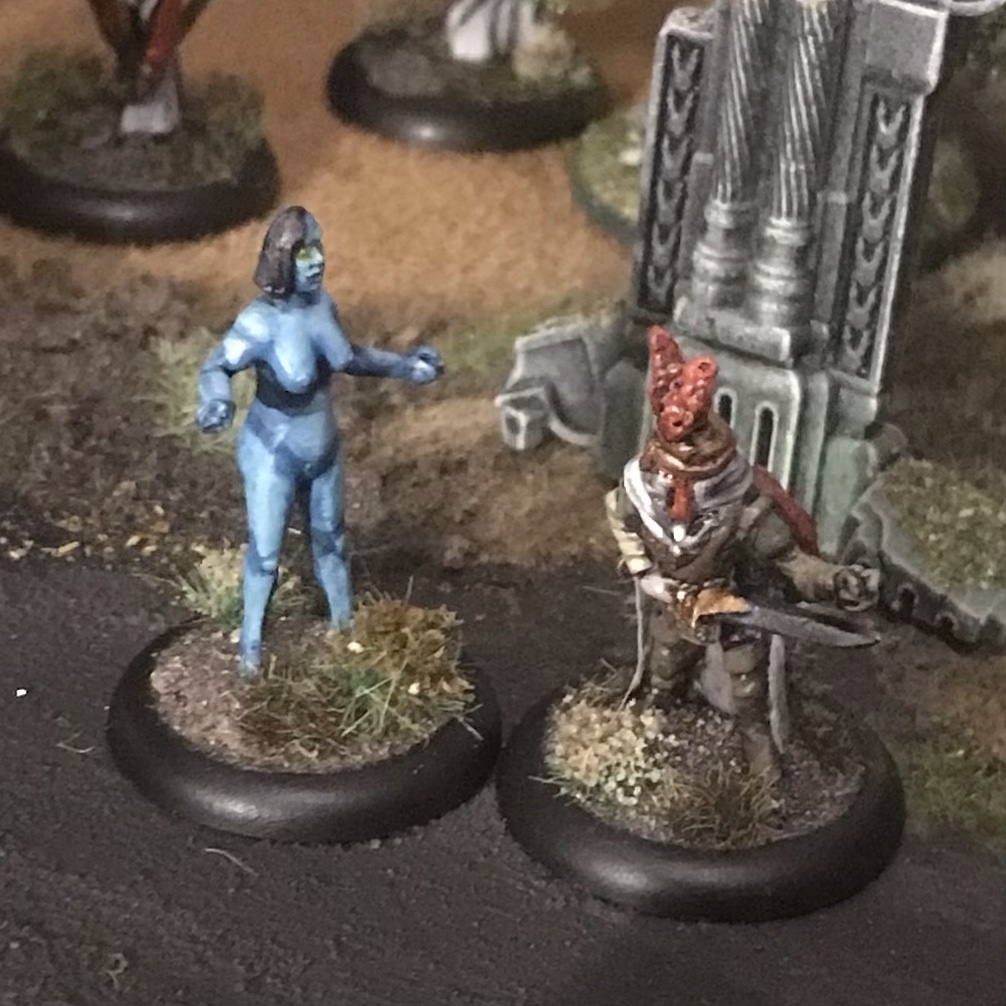
MOVEMENT
Each of your fighters can move up to 2D6” (roll for each fighter individually). Beasts and Drones can move up to 3D6”. Fighters cannot move through enemy fighters and should use terrain in a way that makes sense.
RESOLVING ATTACKS
There are two types of attack: melee and ranged. If a fighter is in base to base contact with an enemy or enemies then they must make a melee attack against that enemy or one of those enemies. If a fighter is not in base to base contact with an enemy then they can select any enemy that they can at least partially see and make a ranged attack against them if possible.
All fighters can make melee attacks, only Soldiers, Drones, Gunners, Snipers, Gunslingers, Monsters and Mechs can make ranged attacks.
To hit their target the fighter must pass an attack check, using their Might stat. Compare the attacker’s Might stat to the target’s Might and roll 3D6 on the table below:
| </=1/4 | </=1/2 | < | = | > | >/=2x | >/=4x |
| 18/16 | 17/15 | 16/14 | 15/13 | 14/12 | 13/11 | 12/10 |
When making ranged attacks Snipers roll 4D6 and discard the lowest result rolled. When making melee attacks Berserkers and Monsters roll 4D6 and discard the lowest result rolled.
For the attack to be successful you must roll equal to or higher than either of the two numbers listed on the table.
IF the first number is achieved – The target is dead. Immediately remove them from play.
If the second number is achieved – The target is marked with a stunned counter. If the figure already has a stunned counter then they are killed as above. A figure marked with a stunned counter cannot move or attack within their controlling players turn and their Might is halved until the counter is removed.
Mechs and Gunners can opt to attack each other fighter within 2” of their initial target. If they do so they must attack all fighters within 2” of their initial target even if they are friendly fighters.
At the end of the Activations phase any of your fighters that are still in base to base contact with enemy fighters move away 1”.
COVER
If the target of an attack was not completely visible to the attacking fighter and the value of the attack roll was an odd number then the attack fails.

DEFENDING
Warriors, Berserkers, Monsters and Mechs can defend as an action. Defending must be the last action the fighter performs this turn. When a fighter defends their Might is doubled until their next activation.

MORALE
At the start of the morale phase roll a die for any stunned fighters you have and on a 5+ the stunned fighter is no longer stunned.
During the morale phase if you killed any of your opponent’s fighters this turn then they must make a morale check:
Roll a D6 and multiply it by the number of figures that they lost this turn. Then roll another D6 and multiply the result by the number of figures they still have in play.
If the result for killed figures is higher that side immediately loses the game. If the result for figures still in play is equal or higher then they pass the test and the game continues.
If the player fails their morale check and has a minimum of 3 fate tokens left and discards all of their fate tokens they count as having passed the morale check.
After the morale phase it is the other players turn. Players alternate taking turns until both players have had 5 turns each then the game ends. If the game lasts till the end of the 5th turn the player that killed the most total points of enemy fighters wins.
POINTS CALCULATOR
The cost of a fighter is equal to their might value. A standard game is 100 points and you can have a maximum of 16 fighters. Additionally at least half of your total number of fighters must be made up of basic classes (Soldiers, Warriors, Beasts, Drones) and you can have a maximum of 2 fighters with a rare class (Monsters, Mechs).


 Deathzap