So I’ve had a brain worm for sometime in regard to Gaol28. I’ve worked on an advanced version and recently I put together Gaol72, but nothing I tried scratched the itch the original rules gave me. It seemed no matter what I tried it broke some of the speed, simplicity and nuances of the original.

I’ve made some progress though and managed a couple of changes that I do think improve things, but these are baby steps. Here’s my original ‘Setup’ section:
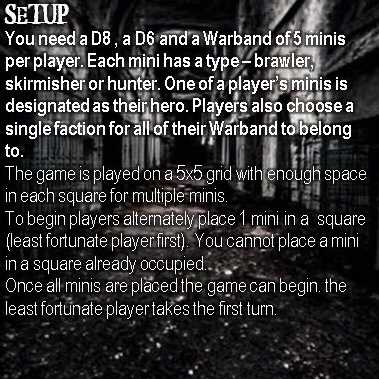
I’ve moved from a 5×5 grid where squares can be occupied by multiple figures to an 8×8 grid where only one figure can occupy a square. The big advantage of this change is that you can get playing if you own a chess set. I’ve also switched to a full set of polygonal dice, but more on that later.
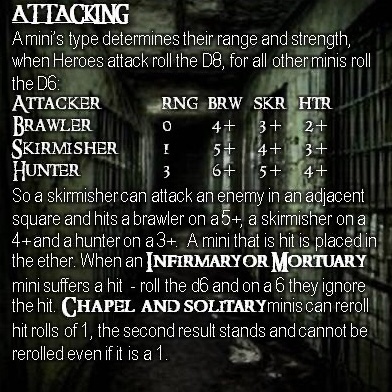
Ranges have changed to coincide with the new grid, Hunters can attack up to 6 spaces, Skirmishers 2 and Brawlers can attack enemies that are adjacent.
Instead of using the grid above I’ve also switched to opposed rolls. Hunters attack and defend with a D6, Skirmishers a D8 and Brawlers a D10. It basically gets you to the same place as the grid but you never need to check a small table for the value you need to roll, you just need to beat the other player’s roll. Additionally it gives you the chance to defend your guys getting attacked, so you feel like you have some involvement in the combat. Heroes roll one die higher (Hunters D8, Skirmishers D10 and Brawlers D12).
I’ve also added some modifiers to give you more reasons to move and worry about positioning:
If a Brawler moves and then attacks they can add 1 to their die roll. If a Skirmisher attacks and then moves they can add 1 to their die roll. If a Hunter does not move during their activation they can add 1 to their die roll.
You can add 1 to the attacker’s roll for each ally they have adjacent to their target.
You can add 1 to the defender’s roll for each ally they have adjacent to themselves.
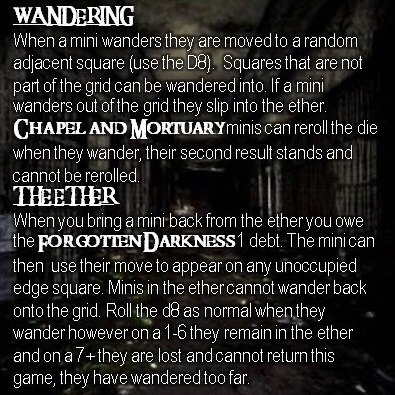
As far as wandering is concerned I’ve realised the mechanic is key to the game, and it is probably one of the best things I’ve ever put into a game without realising. It was too slow in its initial iteration though.
There was a lot of wandering to do after moving and attacking, so I’ve dropped figures wandering that are in the Ether, they just stay put. I’ve also noticed that the change in grid has reduced the number of figures that wander too. Before a figure would wander if it was not influenced, or was not in the same space as an enemy, but now as you can only have one figure per square it’s a figure won’t wander if an enemy is adjacent. This seems to make it so only one or two figures will wander at the end of each turn. Much faster!
Here’s it all so far, I’m still thinking hard about improvements so if you have any ideas let me know.
THE GAOL was only for the worst of offenders, the treacherous, murderers and religious heretics. Removed from maps and abandoned by a government determined to forget those within, the Warden struggled to maintain order. Seeking occult help, the Warden foolishly performed a dark ritual and instead of gaining relief found his prison consumed by a long FORGOTTEN DARKNESS.
Now adventurers seek their fortune by breaking into the cursed walls of THE GAOL, but none ever return, succumbing to the DARKNESS or joining one of the raving bands of madmen within.
FACTIONS
THE WATCH led by the Warden concern themselves with maintaining what little order remains through unrivaled brutality.
THE CHAPEL seek repentance for their wrongs by slaying the monster and demon in the hopes of returning THE GAOL to the real world.
THE INFIRMARY desire to twist what remains of their human flesh to better suit their new domain.
THE SOLITARY, saved from the hangman’s noose by the decay of THE GAOL only want to perpetuate the chaos and bloodshed.
THE MORTUARY collect the bones of the slain to construct strange monuments to a dead god.
CORE RULES
You need a D6, D8, D10 and D12 and a warband of 5 fighters per player. Each fighter has a type – HUNTER, SKIRMISHER or BRAWLER and all of a player’s fighters belong to one faction. One of a player’s fighters is designated as their HERO.
The game is played on an 8×8 grid. Both players roll off and the higher roller places a mini in a grid square first. Then players alternate until all minis are placed and then the game begins.
Players roll off to determine who takes the first turn.
THE TURN
During a player’s turn they can activate any one of their fighters. When activated a fighter can move to an adjacent square and make an attack, can attack and then move or can be moved twice. A fighter cannot move into or through a square containing another fighter. A fighter can be moved off of the grid if you choose, in which case that fighter slips into THE ETHER.
Once the fighter has finished activating, then each of the player’s fighters that were not influenced and not adjacent to an enemy WANDER. Then it is the opposing player’s turn.
ATTACKING
A fighter must target one of their closest enemies. A fighter’s type determines their range and attack die:
A BRAWLER can attack an enemy in an adjacent square and attacks and defends with a D10. If a BRAWLER moves and then attacks they can add 1 to their die roll.
A SKIRMISHER can attack an enemy two squares away and attacks and defends with a D8. If a SKIRMISHER attacks and then moves they can add 1 to their die roll.
A HUNTER can attack an enemy six squares away and attacks and defends with a D6. If a HUNTER does not move during their activation they can add 1 to their die roll.
A HERO will attack and defend with one die better than their type – BRAWLER D12, SKIRMISHER D10 and HUNTER D8.
When attacking roll the attacker’s attack die, and the defender’s defence die.
You can add 1 to the attacker’s roll for each ally they have adjacent to their target.
You can add 1 to the defender’s roll for each ally they have adjacent to themselves.
After rolling either player can add 1 to their die roll, in which case they owe THE FORGOTTEN DARKNESS 1 Debt.
Compare the results:
- If the attacker’s roll is equal to or higher, then the defender is banished to THE ETHER, remove them from play.
- If the attacker’s roll is less than the defender’s roll, then the attack has no further effect.
WANDERING
When a fighter WANDERS they are moved to a random adjacent space (use the D8). A fighter can wander off of the grid and if they do so they slip into THE ETHER. If a fighter would WANDER into an occupied space they do not move instead.
THE ETHER
You can activate a fighter in THE ETHER. When you do so, use the fighter’s first move to appear on any edge space. If you bring a fighter back from THE ETHER you owe THE FORGOTTEN DARKNESS 1 Debt. If the player that goes second activates a fighter in THE ETHER on their very last turn in the game then they owe THE FORGOTTEN DARKNESS 2 Debts.
THE END
The game ends when both players have had 5 turns each. The winner is the player with the most fighters still on the grid with a hero counting as two.
However, before declaring the winner debts are collected. Each player rolls a D8 and adds their total Debts. For each point over eight they score, one of their fighters is claimed by THE FORGOTTEN DARKNESS and moved to THE ETHER, heroes are taken last.
FACTIONS
THE WATCH
WATCH fighters can target any enemy in range.
WATCH players roll a D6 instead of the D8 and add their Debts at the end.
THE CHAPEL
CHAPEL fighters can roll the D8 twice when wandering and pick one of the rolls.
CHAPEL fighters add 1 to their die roll when attacking.
THE INFIRMARY
INFIRMARY players roll a D6 instead of the D8 and add their Debts at the end.
INFIRMARY fighters add 1 to their die roll when defending.
THE SOLITARY
SOLITARY fighters can target any enemy in range.
SOLITARY fighters add 1 to their die roll when attacking.
THE MORTUARY
MORTUARY fighters can roll the D8 twice when wandering and pick one of the rolls.
MORTUARY fighters add 1 to their die roll when defending.

 Deathzap
It does look interesting