Many, many thanks are in order for all the brilliant comments on my last post about deploying apemen. I’ve broken things down into three rough sections, randomised deployment, card based and misc. Here goes:
Randomised deployment:
Place terrain. Pretend the board is a clock face, have players roll a d12 per figure to give each ape-man a segment of the board to deploy in.
Place terrain down and divide the board in quarters, roll 2d4 per figure, the first D4 designates the quarter of the board, the second D4 which quarter of that quarter the ape-man deploys in.
The version using D4s worked better in my opinion and gave a good and random spread of figures so it’s definitely an option. To keep figures away from enemies, I made it so you couldn’t put figures within 3” of enemies, and also rerolled anytime a figure would be deployed in a segment containing an enemy.
Place terrain. Each Ape-man calls a certain piece of terrain their home. In turns both players roll on a table of the different terrain types for one of their ape-men at a time, the piece of terrain they roll is that Ape-man’s home. The player can then place that ape-man within or touching that terrain. Repeat until all ape-men are deployed. This one is random but a little more tactical.
I really liked this idea in principle, however in practice you’re hampered by having multiple different terrain types available. It’s not an issue for most games, but my whole ethos with WOTH is to have minimal barriers to entry. So as a variation on the idea above, I had 6 pieces of terrain, and in turn players would randomly roll for which they put a figure in or in contact with. Rerolling anytime a piece is selected that has an enemy already in/on it.

The big advantage to my mind of this kind of random deployment, is that terrain placement is simple and straightforward. ‘Place terrain’ is all the rules you’ll ever need, or ‘Place 6 items of terrain’. Random deployment means no matter how the terrain is placed no one player can take advantage of terrain placement when deploying.
Other suggestions focused more on the use of cards:
You could use a small pack of cards, each with terrain placements and deployment zones marked. Randomly select one and deploy as indicated. As long as you have a dozen cards or so, I doubt you’d feel there was a lack of options.
Or:
I suggest you decide what terrain pieces you are using. Assign each one to a card, make the deck up to 16. Then lay your cards down, turn them over, put the terrain on.
If you are having ‘attackers and defenders’ then the defenders are each assigned to a terrain piece before the cards are even played. Attackers each come on the board at the random board edge.
If it is an encounter action, give each side a base edge, and they arrive on their base edge randomly where there is no terrain on the edge.
All great ideas, and very similar in a way to the system I tried myself. While not exactly what you’d call peripheral heavy, I think they do present barriers (even though the barriers are small) to the player and require more explanation in terms of rules than I’d like, I’m seriously trying to stick to as low a word count as possible. They’re definitely good ideas though, and ones I’ll certainly be considering for Deathzap, or anything else for that matter.
In the miscellaneous category, here’s a fully fledged scenario, that sounds like it’d be fun to play, especially with a big group:
What if all of the 10 apemen are from the same tribe, just doing their own business (gathering fruits, decorating a cave, making pointy sticks…) ?
Then, players deploy alternatively a numbered / marked fig where they want until all figs are on the table.
At this point, an incident occurs (some apeman make a mean joke about his fellow’s apewoman) and everybody goes apeshit.
Each player draw 5 cards out of a 10 cards deck, determining wich apemen he’s going to play.
Bloodbath can begin.
While not exactly within the scope of what I’d imagined, it could make for a really good game at a convention.
I think I’m settling on the ‘home terrain’ idea, you only need 6 pieces and being non-specific, it minimises any barriers to entry.
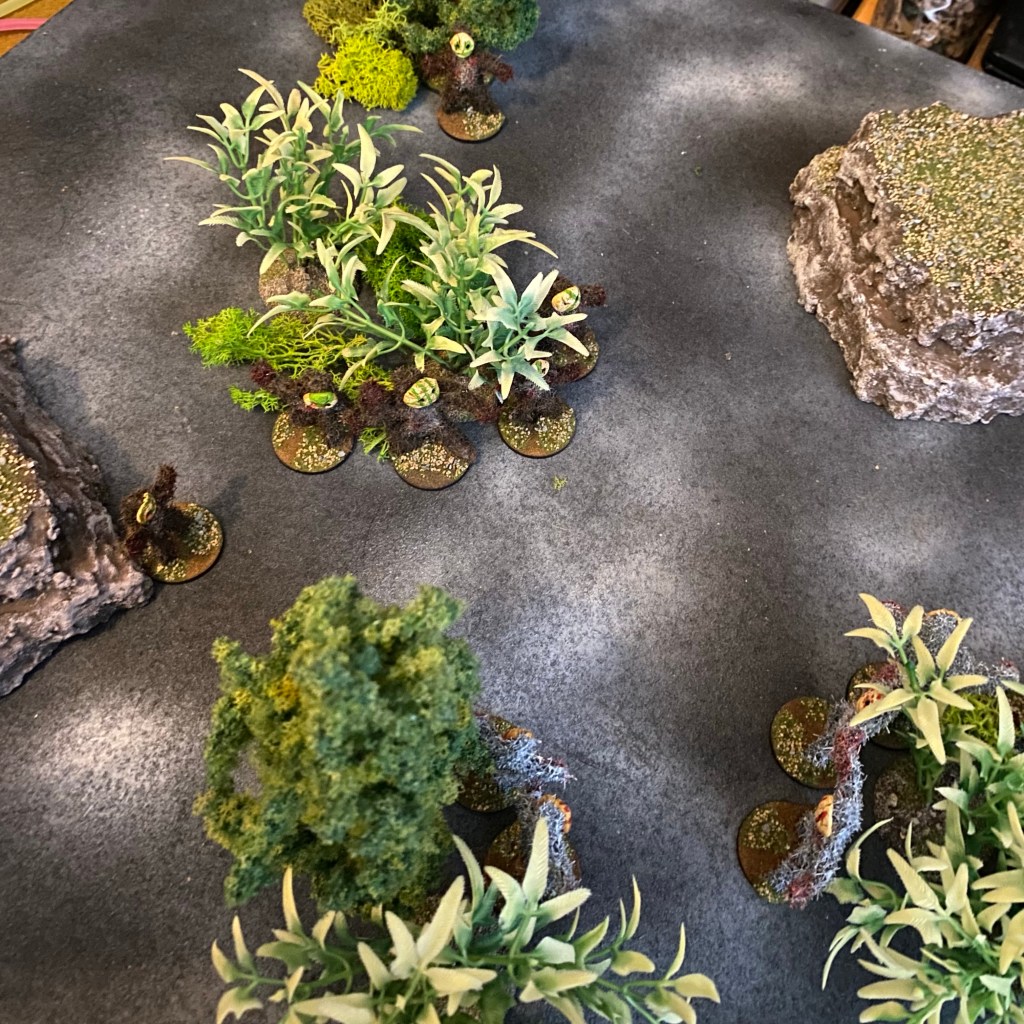
So here are the core rules as they currently stand, have a read through and feel free to ask questions and comment below, if you try it out let me know how it goes.
I think as a ‘core’ goes they’re good fun, suitably random and violent. I’m still thinking about faction rules making your Sasquatches different from your Yetis, a very basic campaign and character progression system (which needs to be equally random and violent), and maybe a table of random events to crop up at the end of each turn.
W.O.T.H 1.0
Each tribe should have 6 Hominids, five Grunts and a Chief. You’ll also need a tape measure, some D6s and some tokens to depict Blood, and specific damage types. You then require 6 pieces of terrain a few inches wide each. The game is played on a 2’x2’ board referred to as ‘the battlefield’.
SETUP
Place the terrain evenly across the battlefield, with each at least a few inches apart, and number each one 1-6. Player’s roll off, then starting with the higher roller, each player in turn selects one of their Hominids and rolls a die and places that Hominid within (if possible) or in contact with that item. If the item rolled has an enemy in or in contact with it already, reroll the die. Once all Hominids are placed the game can begin.
SCENARIO
The first player to score 12 points wins, points are scored as follows:
- Kill the enemy Chief = 4 points.
- Kill an enemy Grunt = 2 points.
- For each terrain piece that enemies started the game in contact with, that you get a Hominid in contact with = 1 point (each terrain piece can only be scored once per game).
Once a player scores twelve points, the game continues until their opponent has had one full turn, and if they score their twelfth point in that turn the game is a draw.
THE GAME
The game is played in turns, players roll off to determine who goes first. Each of a player’s turns has 4 phases:
1- ENRAGE 2- LOB 3- RUSH! 4- SCRAP
1- ENRAGE
Give one of your Hominids a Blood token. Blood tokens boost your Hominids actions, but also bring them closer to death. Blood tokens stay on a Hominid.
2- LOB
During your Lob phase each of your Hominids can Lob a rock at the enemy. Select an enemy and roll a D6, add the number of any Blood tokens on the Lobber, and a further 1 if they are a Chief. If the result rolled 6 or greater then a hit has been scored. Natural 1s always count as misses regardless. A Natural 2 also counts as a miss if the target Hominid is not entirely visible to the thrower.
3- RUSH!
During the Rush! phase you can move each of your Hominids up to 6”, +1” per Blood token a Hominid has.
4- SCRAP
If any of your Hominids are in base to base contact with an enemy then they can scrap. Roll a die for each Hominid adding the value of any Blood tokens they have. Adding another 1 for a Chief. The lower roller is hit. In the case of a tie, both are hit.
Where multiple Hominids are in base to base contact with enemies, in your turn you determine the order the Scraps are resolved in, and each Hominid suffers a -1 modifier per additional Scrap.
RESOLVING HITS
When a Hominid is hit they can make a saving throw, roll a D6 adding any Blood tokens, on a 7 or higher the hit is stopped and the result below is applied, and on a 6 or less it is not, and the Hominid suffers damage. A natural 1 always counts as a failure.
7 Block: The hit is stopped and you can choose to add a blood token to the Hominid that blocked the hit, or to the attacker.
8 Dodge: The hit is stopped and the Homind that dodged the hit can move up to 3”.
9 Counter: The hit is stopped, and the attacker is hit with no save allowed.
10+ Super Counter: The hit is stopped, and the attacker is killed. Roll a die, on a 1-3 the attacker is Dead, on a 4-6 they are Butchered (see DAMAGE below).
DAMAGE
Roll 2D6 on the table below whenever a Hominid suffers damage to see its effect:
2 Slumped: Remove all Blood tokens on the Hominid.
3 Crippled: The Hominid gains a Blood token and moves 3” instead of 6” in the Rush! phase. If the Hominid is already crippled they gain 2 Blood tokens instead.
4 Thrown: The Hominid gains a Blood token, additionally the player causing the damage can move the Hominid up to 3”. If the Hominid moves into any other Hominids they are hit too.
5 Discombobulated: The Hominid gains a Blood token. Additionally the Hominid cannot Lob, Rush or Scrap in their next turn. If the other player has a turn before then, and the Hominid scraps, they automatically lose, or if the Homind must make a saving throw they automatically fail it.
6 Enraged: The Hominid gains D3 Blood tokens.
7 Dead: The Hominid is killed, remove them from play. Their closest ally gains a blood token.
8 Butchered: The Hominid is killed in such a violent, over the top way that all of the killed hominid’s allies gain a Blood token.
9 Blinded: The Hominid cannot Lob for the rest of the game.
10 Confused: The Hominid gains a Blood token and now mistakes all enemies for allies and all allies for enemies. They switch sides.
11 Berserk: The Hominid is killed, and each enemy within 6” gains a Blood token.
12 Explodes: The Hominid is killed, and each Hominid within 6” gains a Blood token.
ACCUMULATED BLOOD
Once a Grunt has 3 Blood tokens, or a Chief 4, each time they gain an additional Blood token roll on the table below and resolve the effect immediately:
1 Cool Off: Remove all Blood tokens from the Hominid.
2+3 Burn Out: The Hominid is killed, remove them from play.
4+5 Berserk: The Hominid is killed, and each enemy within 6” gains a Blood token.
6 Explodes: The Hominid is killed, and each Hominid within 6” gains a Blood token.

 Deathzap
Thank you for the news !
I play tested 2 games with v.1 ruleset (also did 2 games previously with first rules).
Here’s my report (sorry broken english incoming) :
Randomized deployement gives interesting results, it can be tricky when one apeman of a tribe begins alone and surrounded but it does the job : quick and easy to understand (even if special rules might come with some terrains).
Enrage : easy to understand, nothing to add.
Lob : poor terrains placement led to some sniping possibilities across the map. The first version with random range gave me more laugh.
Rush : works well.
Scrap : works well too. Should the loosing hominid be moved backward 1″ at the end of the scrap (if no dodge or thrown) ? If hominids stay at contact maybe something about shooting in a fight should be added.
Damage chart : does a hominid gain a token when blinded ?
Saving : at first I was afraid that it will be less deadlier with a saving system but it works nicely.
Accumulating blood : this is the point where everything can go pretty quick with chain reactions of exploding hominids. Maybe allowing for cool off on a 1 or a 2 ?
The V.1 seems deadlier to me, but I have the impression that being first player give a significant advantage. With V.0 I had more suspense (but I had to arrange something with damage and blood tokens management, maybe did I misunderstood something). It also feeled more easy and beginner friendly.
Again, this is my opinion and feeling, playing with random 1/72 toy soldiers and pieces of home hardware as terrains.
Wow, I’m so glad you gave it a go!
Here are my thoughts, based on your thoughts.
I agree with your points on random deployment, it’s a difficult one, as sometimes you can get screwed over by being unlucky in deployment, but it’s probably the quickest and easiest way to set things up and the game’s already fairy random anyway, so it shouldn’t matter too much.
I switched a lob to hit on a set value, mostly because it seemed the player to go first had a pretty big advantage as it seemed easier to hit enemies in the original version.
You probably noticed that in the original hominids did bounce back 1” after combat, but in the end I found it unnecessary. It’s just extra words that don’t really do anything. A rule about shooting in a fight is a good idea, a lot of my games give you a -1 modifier if you’re not shooting at the closest enemy, which could be good to implement there.
Yes, you don’t gain a blood token when blinded, not sure why though lol.
I’m a big fan of the current accumulating blood system, it’s intentionally designed to end games quickly and violently.
In my games, I think both versions are roughly equal in terms of deadliness but the newer version has less of a first player advantage.
Thank you very much for giving the rules a go and giving such great feedback!