With my recent return to my Ghost Legions setting, of course I drew up a new set of rules. Which I posted here. They’re an okay set, make sense, play relatively quickly, and can give you some difficult choices to make… but are they fun?
Maybe… I guess fun is in the brain of the beholder.
So what makes a set of rules ‘fun’? I’m sure we’ve all played games, games we would even consider good, but good doesn’t always translate to fun. In the same way you might have an experience with a film, a really good film technically, but not enjoy it in that way. So what is fun, and is it something you can aim at while writing? Can it be mechanically broken down?
Here are a few thoughts I’ve gathered over the years.
Random Chance…
Of course Random Chance is an important factor in any wargame, and generally the chances of things happening are far greater than the chances of them happening in real life. Casualty rates are frankly horrifying on most wargames tables, but if they’re not, it can tend to feel like things aren’t really happening. Chance needs to be balanced carefully to feel right. Things that are outside chances, or borderline impossible in real life are catered for. They’re unlikely of course but something that would be a 1 in a million, is closer to a 1 in 100, so something impossible does happen fairly regularly and those are the things that make lasting memories. I still fondly remember the time when I was playing the Star Wars TTRPG as a Storm Trooper and I gunned down Luke Skywalker.
Chance tends to mean dice (though it doesn’t have to) and Donald Featherstone’s original roll to hit, then armour saves, is the basis of so many games it has to be fun. Well, at least from experience I find it fun. All of Warhammer functions on that basis, Bolt Action too (though I guess Cavatore and Priestly had their fingers in both). I tend to find that combination of rolls more satisfying than other mechanics I’ve seen or tried myself. I could not tell you why, maybe they actually are more fun, or maybe it’s just nostalgia.
Limited ‘feel bad’ moments…
I suppose a lot like the idea of ‘fun’, the idea of a ‘feel bad’ moment is difficult to define. But I think it’s a moment where you don’t get to do a thing. The most obvious example of this I can think of is a failed order check in Bolt Action. In any game there will inevitably be moments like this, so it’s not to eliminate them entirely, however I think limiting them is key. Of course a game entirely of those kinds of moments would be a pretty awful experience for all involved.
Yes and…
I’ve got a theory of gaming, especially solo gaming, that much like the classic rule of improv comedy, the answer to every question needs to be a ‘yes and’. Maybe this is to counter those ‘feel bad’ moments, so if a moment does feel bad it’s also a little unhinged, so at least somewhat comedic. But I’m thinking more about, a game in which the state of play constantly shifts. Maybe a combat system that delivers a little more than just casualties and suppression. Two forces getting bogged down and pinning each other at opposite ends, might make for a realistic game, but it won’t be a fun one certainly not for the solo player. Fun games need to tell good stories to be fun, a bunch of blokes charging forwards and chopping people up isn’t the most exciting story either. There needs to be ebbs and flows, highs and lows, keeping both players on tender hooks, they need to feel like they’re always in with a chance.
Good lore…
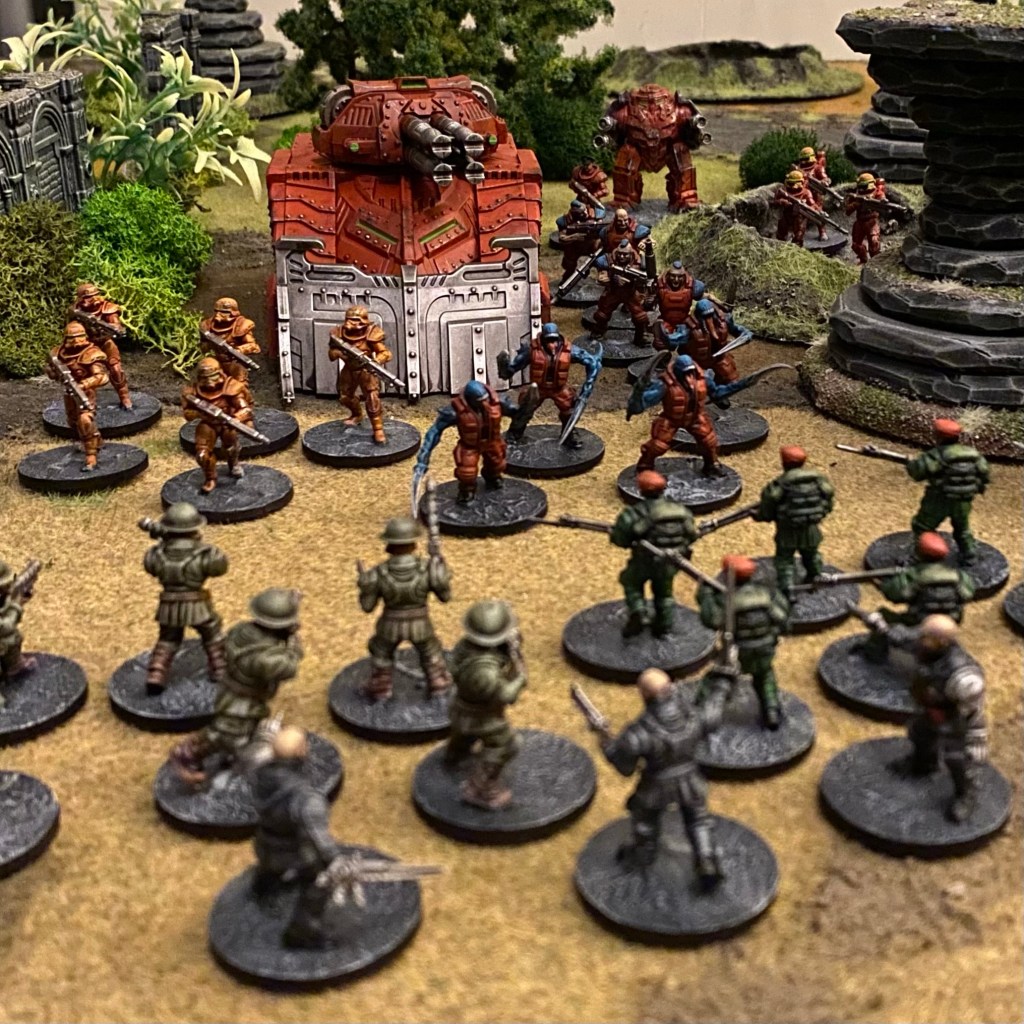
If you’re doing a real battle, then you needn’t worry, however for the fantasy and sci-fi gamers among us, I think a strong setting is a key element for a fun game. This is probably Warhammer’s biggest asset, and helps along their always overly complicated, often mediocre, some times poorly written rules. It’s about not only fighting a battle, but feeling that the game is part of something larger that spreads beyond the edges of your table.
Difficult Choices…
A fun game needs to give you puzzles to solve, to allow your opponent to create difficult puzzles for you, and to allow you to create difficult puzzles for your opponent. Say you need to kill something before it kills a key unit of yours, but you also need to take an objective on the other side of the table, and you can’t do it all at once so you have the trouble of prioritising tasks and positioning enough resources to get those tasks done. If all you’re doing is charging forwards blindly, it may be fun the first few times, but that will wear thin pretty fast.
There’s a lot of factors that contribute to that kind of set up, good terrain to restrict movement making you divide up your assets, a good scenario to force movement again to force you to divide up your assets. Differing abilities for units, so a unit is stronger against some enemies, but weaker against others. A dynamic turn structure that forces you to prioritise your options.
Of course ‘fun’ is whatever you find fun in the end. Maybe it’s in constructing a deep simulation of some historical period, maybe it’s in pure strategy. I think I’d find a game of ASL or Chess satisfying, but enjoyable in a different way to a game of Bolt Action or 40k. Are those things fun? Maybe…
Let me know your thoughts below!

 Deathzap
I would add “cinematically plausible.” A game you recall as if it happened in real time, like you’d watched it happen on a screen because the events that played out on the table were so memorable. (Or is that just me?)
cheers
John
I remember reading Hacket’s Fantasy Wargaming; he used a percentage dice and a ‘1’ allowed a humble hobbit to kill a dragon.
In my own wargames I use chance factors for various unusual events. In my fantasy campaign we roll for the random events every third game. These events include raiding by third countries, bumper harvests, plagues, ‘time travelers’, angels, special hero characters or aliens appearing and so on. One event was an appearance at one’s capital, of lady Godiva and the troops, consequently, refusing to leave.
Yes, that makes a lot of sense. Thinking about it now, I can see how some games really cater for that and others don’t as much, or have things happen in an implausible order.
Do some get their eyes gouged out afterwards?
Fun! I sometimes wonder what it was about those childhood or teenage early makeshift games that appear so epic and enjoyable in (rose-tinted spectacled) hindsight and that we often in vain try to recapture the “spirit of …”
Simplicity in rules may partly be it? (Thanks Donald Featherstone)
Yes, being a kid and having the ability to have your imagination so easily captured by something, definitely made the games of those earlier years more fun. Also not understanding half of the rules you attempted to play made them feel esoteric, magical even.
Maybe, sometimes, a little bit of nonsense leads to a fun game.
I stumbled upon The Great Emu War wargame, made by 2D6 Wargaming along with 6mm minis.
I gave it a try and it was, by my standards, fun enough.
https://www.2d6wargaming.com/products/emu-war