Comments and questions posed previously on my Ghost Legions posts have lead my head down a rabbit hole over the past few days. It’s a rabbit hole I’ve gone down briefly before, but now I am exploring it somewhat further, hopefully to the underworld of answers itself.

But before getting too esoteric, before I consult a medium or Ouija board to find out how ghosts operate, let’s think about the game.
Ghost Legions was originally intended to make use of those mismatched boxes of 1/72 figures you can find in any good UK high street model shop. The urge to buy 50 Confederate infantry is strong, even though I don’t have any Union troops for them to face and even though there are no cavalry or artillery to see in the piles of 1/72 figures available, and even though the thought of painting them makes me break out in cold sweats. Even so… I find myself possessed by possibilities and waddle over to the counter to exchange my hard earned pocket money for more tiny people (that can’t be a problem unique to me).
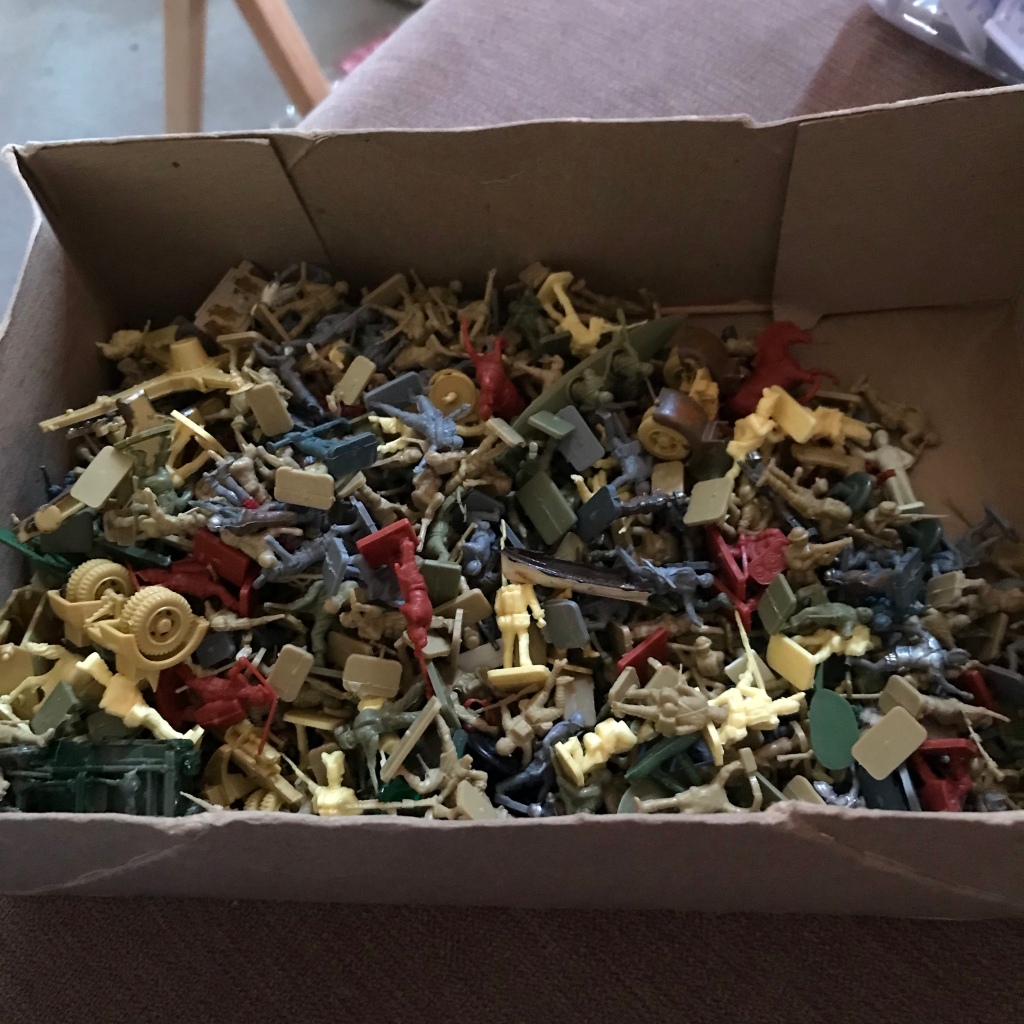
As Ghost Legions has developed, I find myself leaning towards grid based movement and without realising it that solves several other problems that may plague your average historical wargamer. Multi-based miniatures versus single based miniatures is possible. Differing scales can also be played against each other (if you can stomach such heresy, may Imps poke hobby knives into your bum for eternity). It’s not anyone’s fault that you decided to collect exclusively for Chaco War in 54mm, but if you want to actually get your Bolivians on the table a game of this nature this may be your best option.

So problems partially solved aside, let’s talk about the problems ahead, as there’s a fairly big fork in this rabbit hole.
Namely, do I take a strict historical accuracy route? Accurate in the sense that figures operate in a way that they did historically (although that’s not a simple as it sounds).
Or do I simply nod to historical accuracy and think of this as a purely fantastical exercise?
Take two differing approaches –
On the fantastical side, I imagined that ghosts not being physical entities need bother themselves with the laws of physics, but ghosts operate more in terms of what they believe they can do. So if a Roman thinks he can hurl his Pilum through a tank’s armour he can, if he thinks his shield will deflect bullets it will (unless his opponent is more confident that his bullets would penetrate a shield). Morale and the influence of leaders should be more of a factor in the outcome of the conflict than anything else really. Of course equipment will still operate in a semi-realistic way, as a ghosts initial thinking will be based on their training and battlefield experience while alive. This is all a justification for plate armour providing some protection from modern weaponry and the rather unrealistic weapon ranges often seen in wargaming.
On the realistic side, I received a fantastic comment on my last post from the great Jim Webster:
‘The other thing to do with the tank is to remember the limited visibility it has. Place it (metaphorically at least) on a piece of A4 paper and unless the tank commander has his head out of the turret (thus is a target) the tank cannot see anything on the paper.
Once infantry are in contact with a tank they can immobilise it, from the Tank Encyclopaedia (but I’ve read it elsewhere) The idler was held in place by a single unprotected bracket. While this allowed the crew to tighten the track tension easily, it also made it vulnerable to enemy fire. One report shows one Australian soldier managed to immobilize a Type 95 by hitting the idler mounting with his rifle bullet.
So infantry will be able to immobilise the tank. Also they’ll be able to drop burning liquids onto the engine and set the tank on fire.
After all your chaps are not facing a tank for the first time, they’ve obviously worked out their strengths and weaknesses.’
This had my head spinning on the ‘historical accuracy’ side. I had always assumed it was madness to pitch ancient troops against modern ones, but it may not be that mad at all. However the ‘accuracy’ side does get complicated.
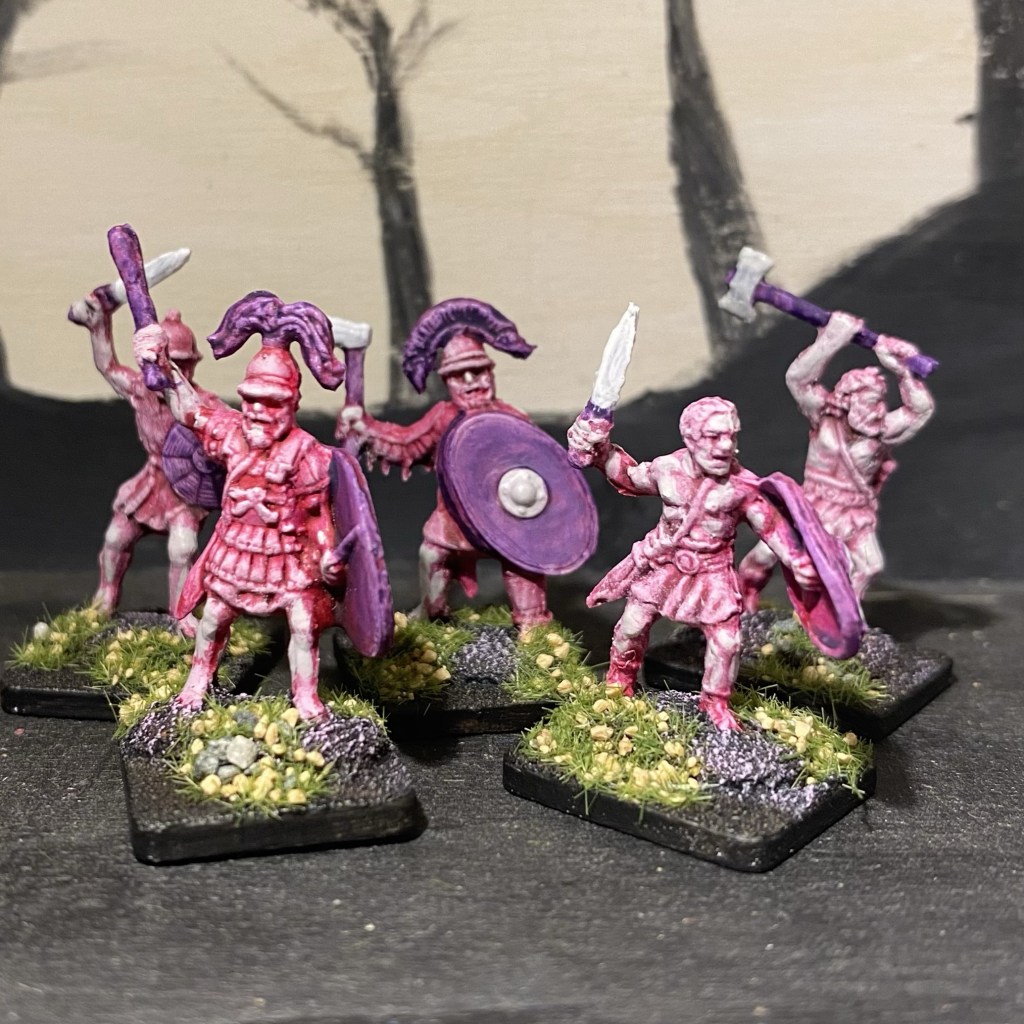
Spartacus and his men would be extremely unlikely to operate anywhere close to the way they did while alive. After 2000 years of warfare in the underworld I suppose it’s highly unlikely any of Spartacus’ men would still be around (alive…?), but assuming they have survived that long and in enough numbers to be an effective fighting force, they will have had to deal with huge advances in technology and the nature of warfare will have drastically changed.
You can imagine the ancients abandoning large formations for hit and run style ambush tactics, utilising their experience of the terrain to their advantage. Ironically, it would be a good idea for modern forces to try and pull the ancients out into the open where they can easily gun them down, rather than try to fight them in places where ambushes are easy. So even modern tactics would need to be adjusted.
This is obviously all assuming that ghosts can’t share or steal equipment from other ghosts. You get what you died with, or maybe used in life (if you died elsewhere), that’s why all ghosts still have clothes on when actually should be running around naked with their shoes on (as clothes don’t have souls last time I checked).

 Deathzap
Interesting that swords (and axes) often had names, in the ‘Dark Ages’ at least and were often assumed to be imbued with a certain power. (This might be because they were a damned big piece of ‘cold iron’ and thus almost magical. So the sword might indeed ‘have a soul’
But if I read it right, US marines in WW2 were metaphorically at least married to their rifle, and I’ve read of marines who when called up for Korea were issued with the rifle they’d handed back in 1945. So perhaps there is something ‘magical’ there as well
I like the concept you are working towards. You want some variation of weaponry and tactics to coincide with the different choices of figures and as they are ghosts, ancients can get away with more things than they could if they were still alive and fighting modern infantry.
However, looking at all of them primarily as ghosts some basic supernatural issues present themselves: They are already dead so how can they be killed? I suppose they become double dead and are vanquished to another realm. If they are ethereal, how do THEY harm anyone? maybe their icy touch (and the icy touch of their ethereal weapons still harm).
I have used ghosts in some fantasy games and I borrowed Warhammer rules for it. The strange thing is the enemy can’t kill them normally in close combat. Instead, if the non-ghosts have rank bonus (up to 4 ranks) or/ they can ‘kill’ the ghosts to the extent that they ‘beat them in combat. There are also some magical weapons and beings that can harm them with normal attacks.
Ghosts on ghosts? maybe they just operate towards each other as they would if both sides were alive.
One more thing – they can pass through material objects, presumably, counting tanks.
I didn’t mean that to be anonymous. This is James from Quantrill’s Toy Soldiers.
On tanks / armour generally, can a ghost simply pass through in the manner that they are supposed to do with walls?
I feel like the ghost’s attributes would be relative to those of their living counterparts in every respect. Ghostly machine gun bullet penetrates ghostly chain mail, etc.
The 2 key differences would be they’d get back up at some point and do it again; and the interesting factions / alliances you could create with your armour supported by Hun cavalry and machine gunners alongside your legionnaires, etc. BUT, no cossing the time streams! No vikings driving IFVs.
I’m anonymous! Not that John is exactly distinguishing…
Unless the tank is a ghost tank, manifested by the ghostly powers of the crew. So rather than a haunted tank it’s just a ghost tank.