This may not make too much sense just yet, as I’ve not posted the rules in full, however I’m still very much playtesting this thing, and trying to get the points costs balanced.
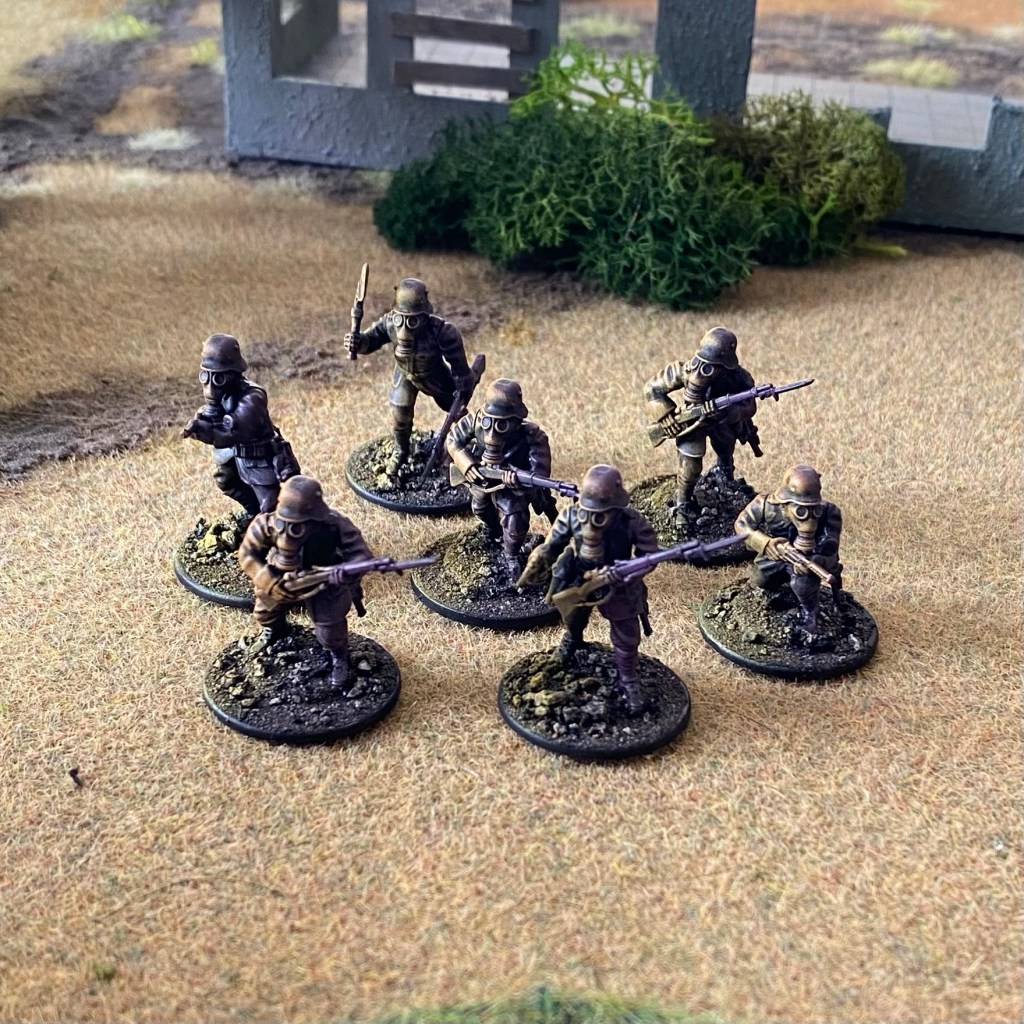
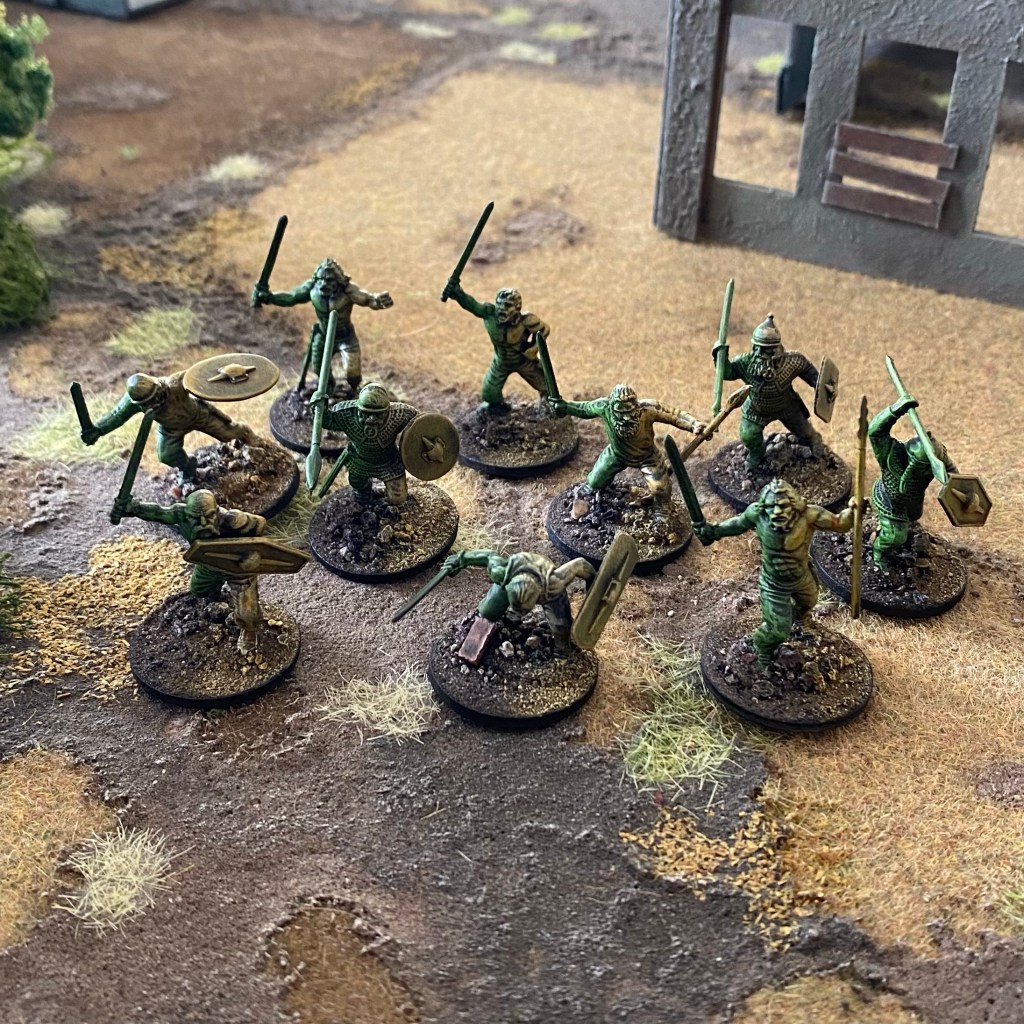
Here are my very basic points calculations:
Armour Save (light) 5+ = 6pts
Armour Save (medium) 4+ = 9pts
Armour Save (heavy) 3+ = 12pts
I counted light as little to no armour, basically naked or just wearing a helmet. Medium was around 50% of the body, and heavy is full coverage. Because I’m having ghosts fight ghosts I chose not to differentiate between technological advancements in armour, I just went with what looks tough and what doesn’t. The armour save is the basic cost of the figure, to which you add equipment. However, it’s always assumed if you take nothing else they’ll have a melee weapon automatically, like a club, sword or entrenching tool, so they’ll always roll at least one die in melee.
A ranged weapon is costed based on its range and rate of fire:
Weapons Range:
(Pistols and thrown weapons) 6” = 2pts
(SMGs, Shotguns, Muskets) 12” = 4pts
(Assault Rifles, Black Powder Rifles maybe?) 18” = 6pts
(Rifles, LMGs) 24” = 12pts
Of course this is a rough guide, and based more on precedents set by wargaming rules rather than reality. Range is not the weapon’s maximum range, that’s double the distance listed above.
Rate of Fire:
(Slow to reload weaponry, Black Powder, Crossbows and thrown weapons) 1 = 3pts
(Single shot weapons such as Bolt Action Rifles and possibly bows?) 2 = 6pts
(Semi-Auto Weapons) 3 = 9pts
(Full Auto Weapons) 4 = 12pts
I’m aware that the values above puts pump action shotguns at a distinct disadvantage, coming in at rate of fire 2, which is beaten outright by fully automatic weaponry such as SMGs, despite them (I assume) performing similarly in close firefights, I may have to give shotguns and any shotgun like weapon such as a blunderbuss a special rule to boost them a bit.
An example weapon would be a Bolt Action Rifle, with a range of 24” and a Rate of Fire of 2 it costs 18 points, and if I give that to a WW1 soldier with light armour (just a helmet), they come in at 24 points total.
Additional equipment is as follows:
Shield (+1 save, +1 die in melee) = 8pts
Extra melee weapon (+1 die in melee) = 4pts
Two handed melee weapon (-1 enemy save in melee) = 4pts
Mounted (+1” move, +1 die in melee) = 8pts
Upon reflection after my game I think some tweaking is in order, maybe I’ll play a couple more before I come to any solid conclusions, however my instincts are telling me that weapons with a rate of fire of 1 should be cheaper and weapons with a rate of fire of 4 should be more expensive, also shields are maybe over costed.
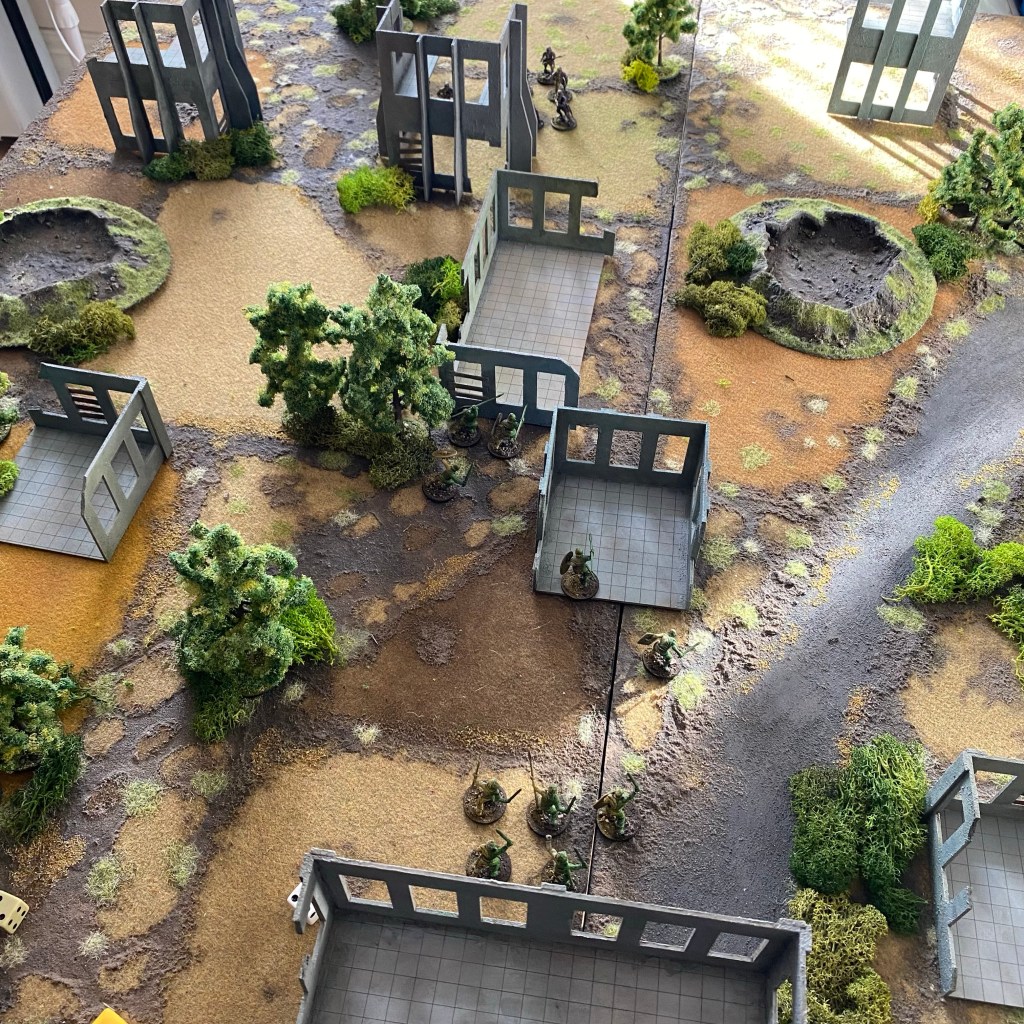
I stuck with the same scenario as before, get a guy off of the enemy’s table edge and you get 2 points, kill an enemy and you get 1, first to 10 wins.
The activation system remained the same, players take turns activating multiple figures. You don’t know how many figures you’ll get so you need to pick the order your guys go in wisely. You get your first for free and then you need to roll above the number of figures you’ve activated so far to activate your next figure, if you don’t your turn ends. I was using a D6 initially, which I then bumped up to a D10, and I’ve now landed on 2D6. The 2D6 means you effectively get your first 2 guys for free. I’m not sure statistically how many figures you should expect to activate each turn, with 2D6, if you’d like to figure that out for me please do and pop it in the comments.
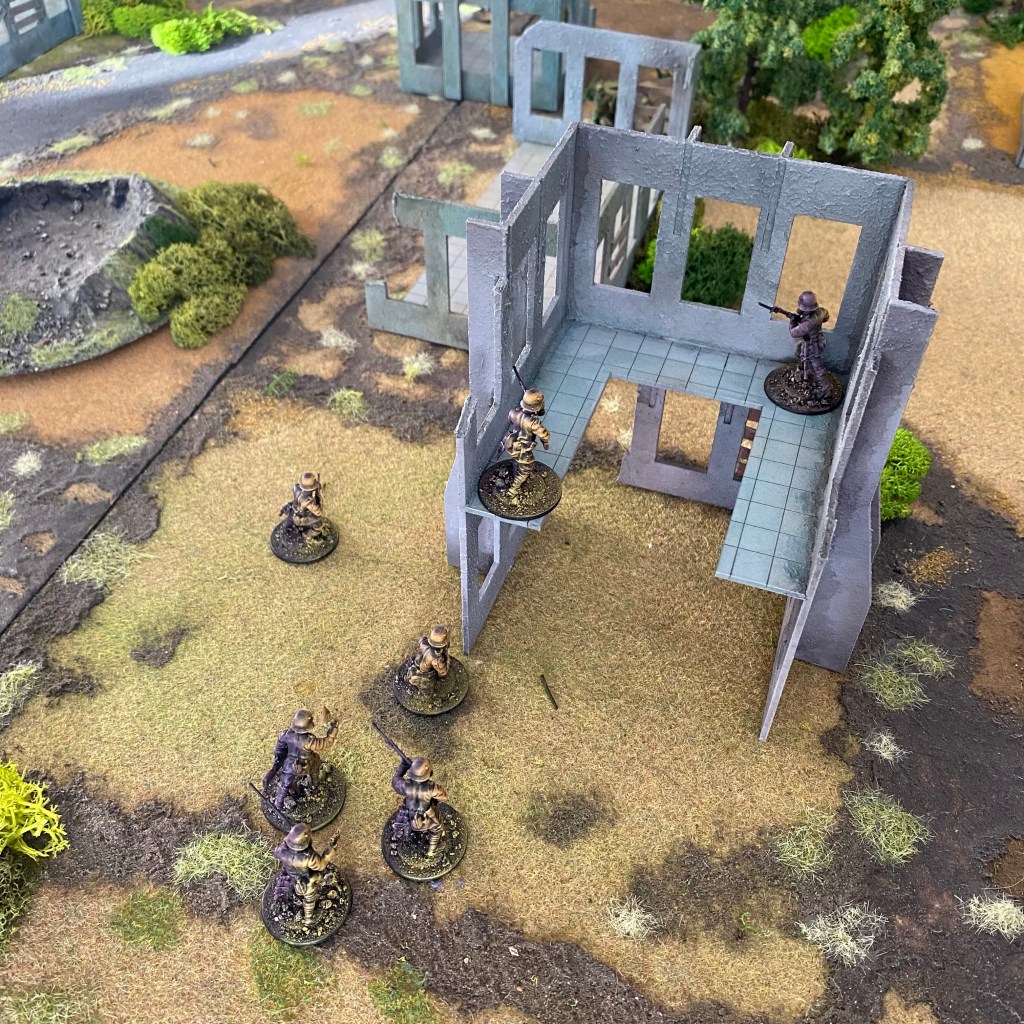
When a figure is activated they get D6 actions. For 1 action they can move 2”. I’m thinking about adding a sprint when they can move 3” provided they don’t perform a ranged attack during their activation. Which would help out those melee heavy forces, maybe to balance it, I could add in the rule that guys in heavy armour can’t sprint?
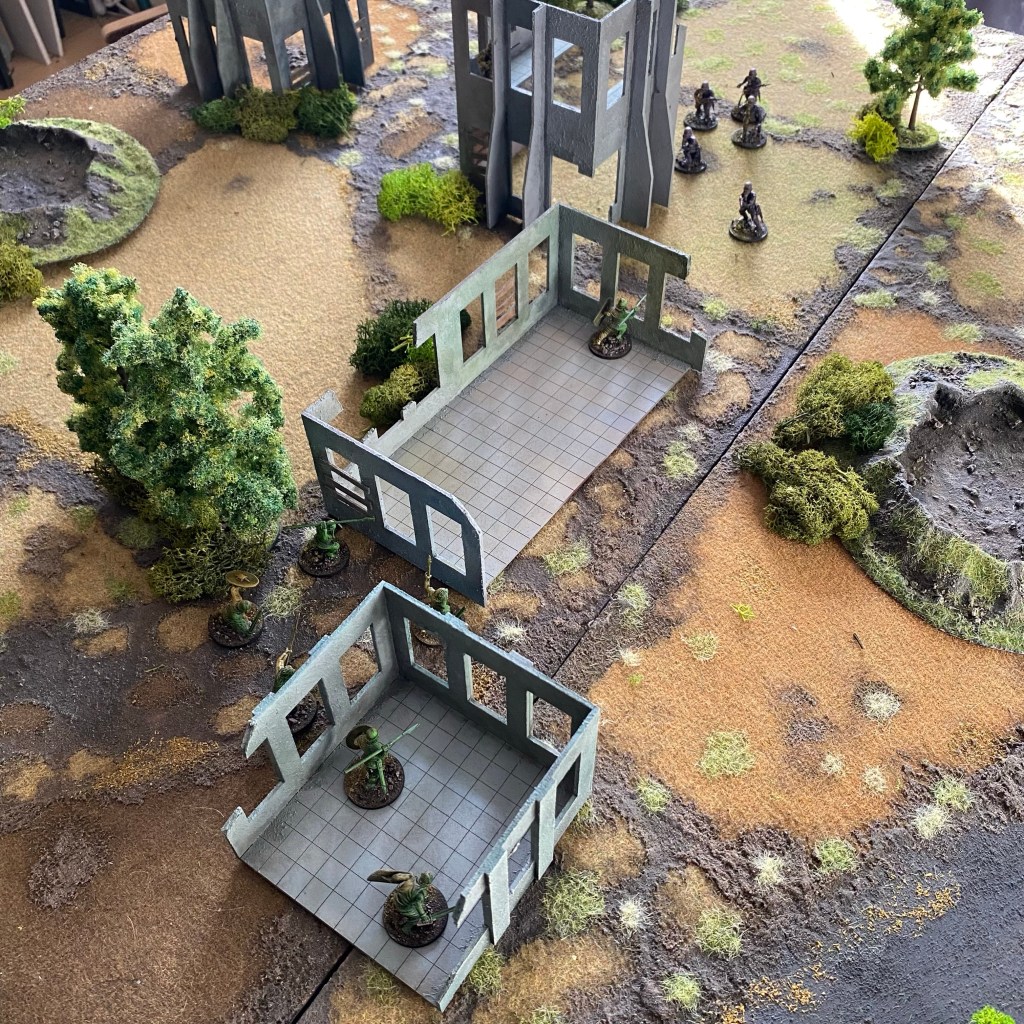
For a number of actions a figure can make a ranged attack. The number of dice they roll for that attack is equal to the number of actions they spend multiplied by the rate of fire of their weapon. For example a figure armed with a SMG with a Rate of Fire of 4, spends 3 actions, and so rolls 12 dice.
You follow the standard roll to hit, saving throws sequence. The roll you need to hit is based on the range to the target and their cover, I’m using the same table as before:
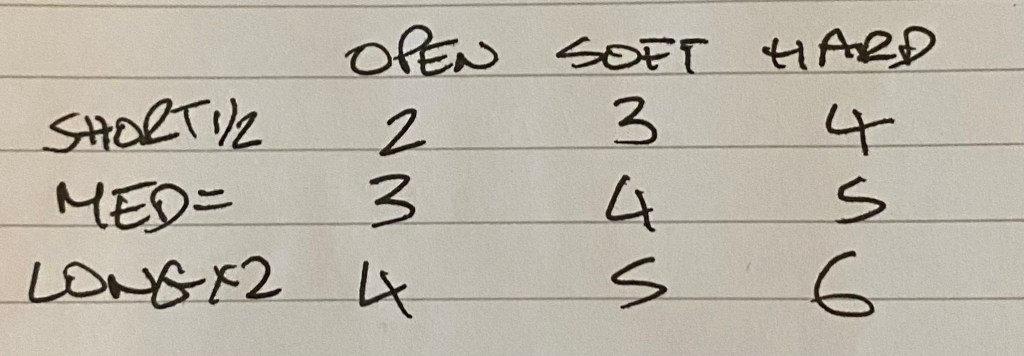
Short is within half of the weapon’s listed range, long is up to double. So an SMG with a range of 12” means Short is 0-6” and Long is 12-24”.
Saves are then based on the target’s armour, and if they’re armed with a shield or not:
Light Armour – 5+, Medium 4+, Heavy 3+. +1 for a shield.
Of course this is very much fantastical, chainmail won’t stop bullets, but in my ghost fights it does because that’s more fun!
Each failed save puts a hit on the target. I keep track of the number of hits on figure with little dice.
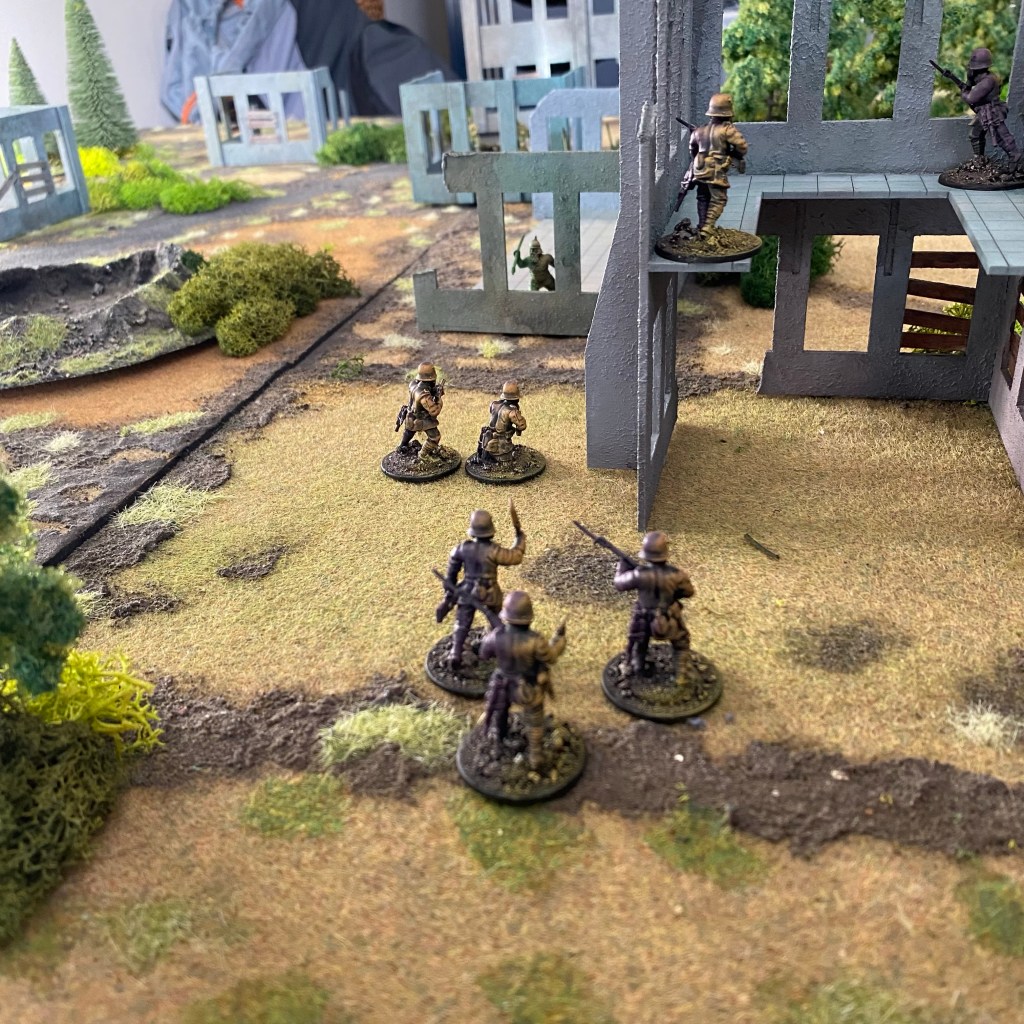
For 1 action a figure can remove 1 hit on them. If the figure is unable to block all their hits in a single activation then they are killed. A roll of 6 lets you block all hits regardless of how many you’ve got.
I’ve debated if you can do this on purpose, have a figure act suicidally choosing not to block their hits, especially when they’re an almost lost cause (on 7 hits or higher), but this only benefits guys with guns as in melee a figure gets to roll an additional die for each hit on their opponent so there’s no real point in the suicidal charge into melee.
The other rule I’m thinking of adding is that if you roll a 6 and block all those hits, that figure can immediately go again. In my game I had a Goth who managed to survive a huge amount of fire by rolling 6s to activate however he was essentially stuck in place. As cool as it was to see him survive the odds (well eventually his luck did run out), he couldn’t do anything else.
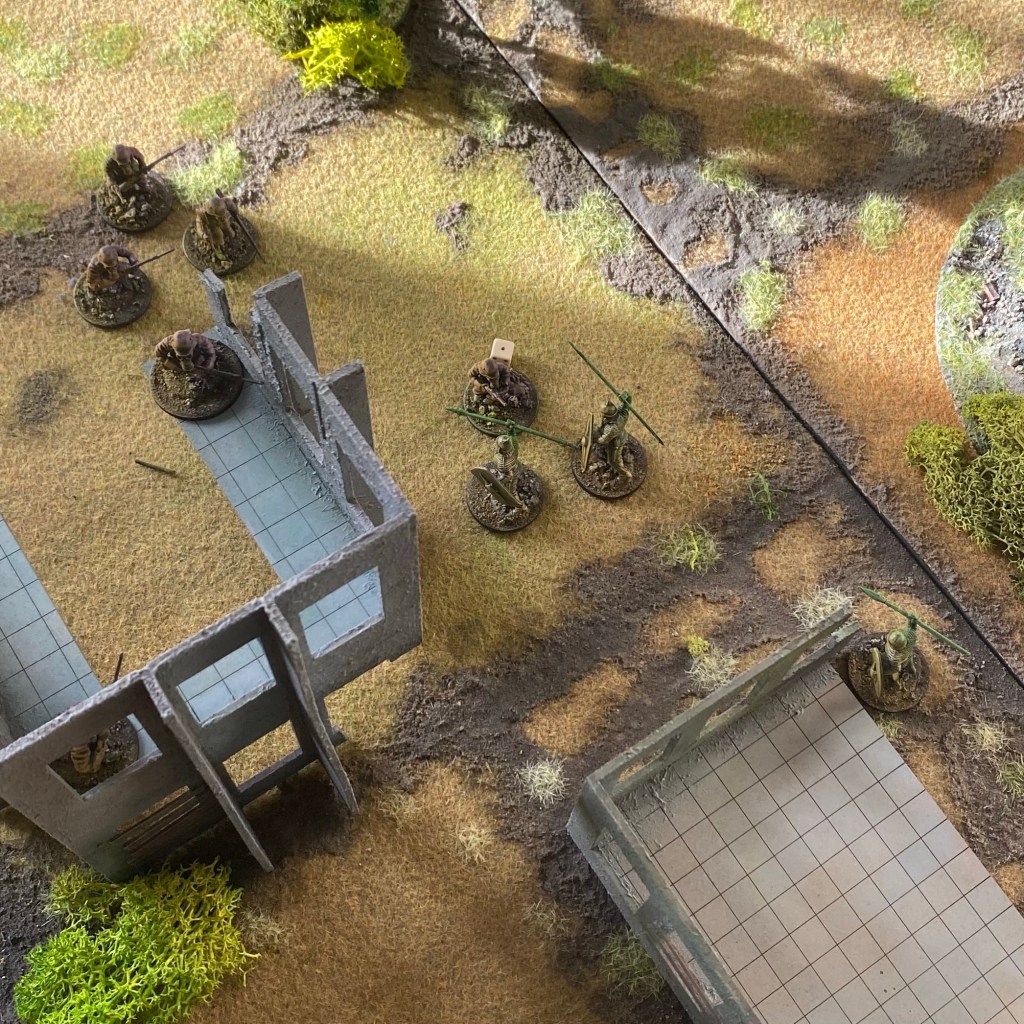
Melee played out in the same way as described in my previous post, both combatants get a pool of dice to roll, trying to score failed saves for their opponent so rolling low in melee is good. Each combatant begins with 1 die, they then get extra dice as follows:
+1 for charging
+1 for an extra melee weapon
+1 for a shield
+1 for each hit on their opponent
The figure that scores the most hits wins and their opponent is killed.
It doesn’t cost a figure any actions to engage in melee, they just have to be in base to base contact with an enemy. However, they can only do it once per activation and at the end of the combat their activation is over.
To give things a little more personality, I’m thinking of adding a ‘long’ rule for spears, halberds and guns with bayonets. What they do is negate any charge bonus for enemies without ‘long’ weapons. I didn’t in this instance, but I’m also planning on making the enemies save 1 worse for two handed melee weapons.
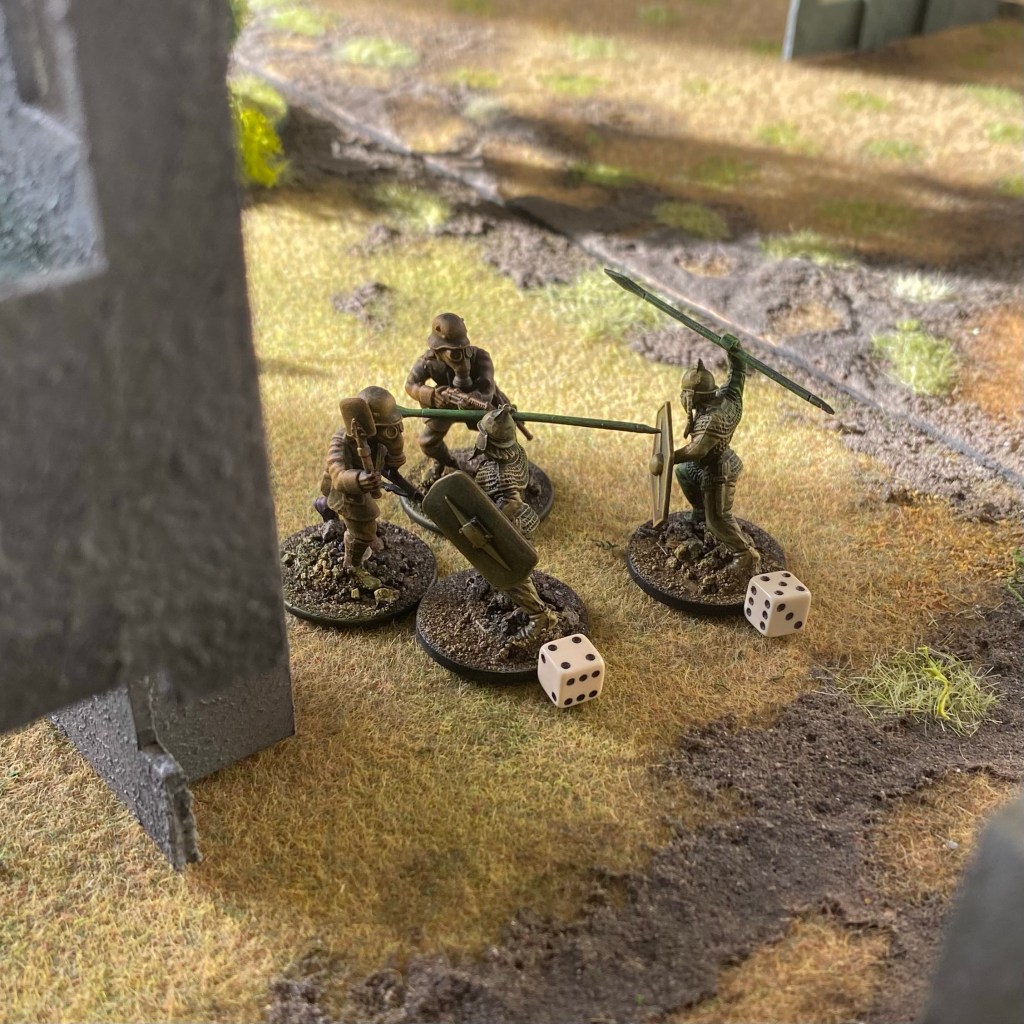
My game turned into a fairly basic charge. I was hoping the Goths would have performed a little better in getting up close and personal with those Germans, however, the firepower of those SMGs and rifles was too much. For a javelin to be truly effective, you’d need to have your figure very close to their target, throw it to add hits to the enemy and then leave yourself enough actions spare to get your figure into melee in the same activation. I can’t complain too much about that, after all that’s how javelins are used… so I’ve just stumbled upon a situation where my rules reflect reality. Maybe a few slingers would be useful to solve that problem entirely for my Goths, so they’re not reliant on javelins for suppression.
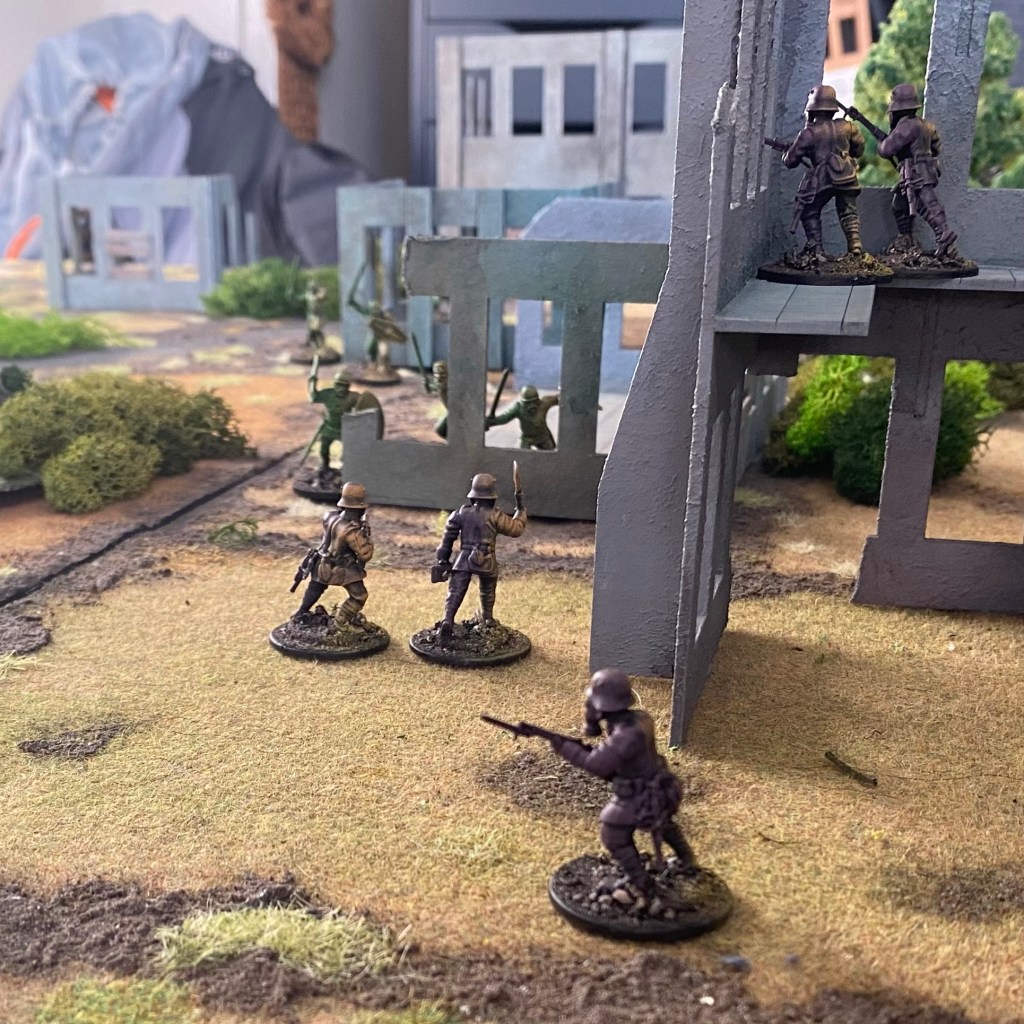
Well, that’s all the rules I played with, the core of the system as it were including those all important points. The Germans won due to overwhelming fire power, maybe the tweaks I’ve mentioned can swing things for the Goths (hopefully not too far).
I’ll check back in on this one after a few more games.

 Deathzap