The perfect ruleset doesn’t exist. In the same way that the perfect tool doesn’t exist, there are different tools for different jobs (unless it’s a Shoggoth, in which case the perfect tool doesn’t exist).
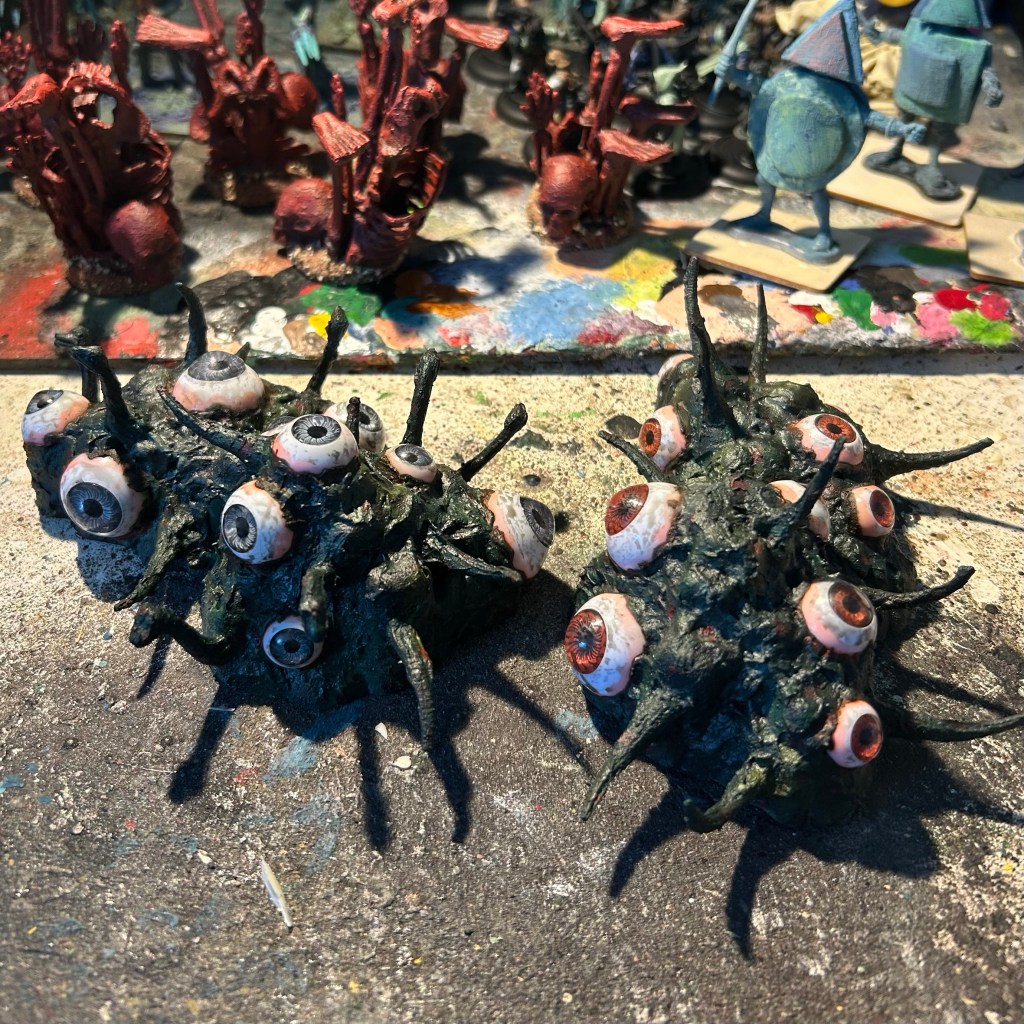
Mentally I’ve been compiling all of my latest odd creations into a single setting, a setting I’m calling Chob-Noggoth, a city, somewhere between a fantasy world and a sci-fi future, which is largely violet and very tongue in cheek.
I mentioned before that I was looking for Esoteric rules to play with all of these odd things, and I’ve been down many different avenues. But one thing I keep coming back to is simplicity. One of the best things about most things… from an evolved ape brain’s perspective anyway… is mystery. The problem with many rulesets is the lack of that, and I suppose you can’t write that in… for a game to function things need known values… you can’t just roll a die if you don’t know what value needs achieving, what denotes success and what denotes failure.
The problem though is that I want a little bit of mystery in this setting, because it’s strange, funky and very flexible. I don’t want things statted, and statistical analysis applied to combat etc.
Simplicity seems like a good way to avoid all that. While simplicity is easily calculated, it’s almost worth not bothering, simplicity is also swingy meaning odd things can occur more often.
One of my favourite rulesets I’ve ever written was Gaol28, and this had a lot to do with the combat system, a single roll would either kill an opponent or not, regardless of who they were:
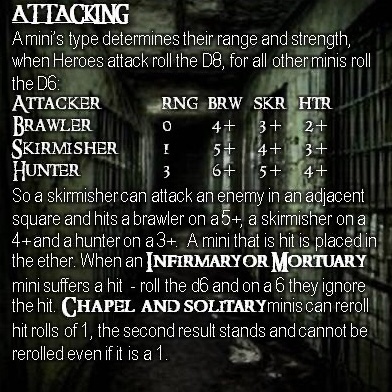
This made every interaction brutal and dangerous, and for me (often playing solo) that made things fun.
So thinking of the basics… here’s what I scribbled:
Side A Moves
Resolve Melees
Side B Shoots
Side B Moves
Resolve Melees
Side A Shoots
End of the Round
Figures are referred to as Warriors.
A Warrior can be a brawler, a hunter or a Skirmisher.
Under special circumstances a Warrior can be a Mage or a Monster.
Brawlers can only make melee attacks and generally hit and save on 3+.
Hunters can make ranged attacks up to 24”, and generally hit and save on a 5+..
Skirishers can make ranged attacks up to 12”, and generally hit and save on a 4+.
Mages can make ranged attacks at any range, always have line of sight, and ignore cover when shooting, and generally hit and save on a 6+.
Monsters are randomly generated, see below.
A warrior (not including monsters) can also be bad, standard or heroic.
Bad warriors will only roll 1 die to attack and can only take 1 wound before dying.
Standard warriors roll 2 dice to attack and can take two wounds before dying.
Heroes roll 3 dice to attack and can take 3 wounds before dying.
Bad Warriors cost 1 point, Standard Warriors cost 2 points and Heroes 3 points.
Moving – Warriors can walk 4” per move phase, or can run 6” if they do not shoot in the same turn.
Warriors can move an additional 2” if they are mounted. Warriors cannot move through other warriors and should use terrain in a way that makes sense.
Shooting – Select a target for the warrior to shoot that is within range. The warrior then rolls a number of dice (Bad 1, Standard 2, Heroic 3), needing a 4+ to hit if they are a Skirmisher, a 5+ to hit if they are a Hunter or a 6 to hit if they are a Mage. If the target has cover (not entirely visible for any reason), -1 to hit. Cover doesn’t affect the shots of Mages.
Any 6s rolled are critical hits and automatically wound the target. Any other hits can be saved against. The target then makes any saving throws based on their type – Brawlers 3+, Skirmishers 4+, Hunters 5+, Mages 6. Each failed save results in a wound.
Melee – The warrior that moved into contact attacks first, then if their opponent survives they can attack back. After both warriors have attacked, if both are still alive, the warrior that suffered the most wounds is pushed back away from the winner 2”. If an equal number of wounds are suffered, both warriors fight again (in the same order).
When a warrior attacks, the warrior rolls a number of dice (Bad 1, Standard 2, Heroic 3), needing a 3+ to hit if they are a Brawler, a 4+ to hit if they are a Skirmisher or a 5+ to hit if they are a Hunter.
Any 6s rolled are critical hits and automatically wound the target. Any other hits can be saved against. The target then makes any saving throws based on their type – Brawlers 3+, Skirmishers 4+, Hunters 5+. Each failed save results in a wound.
Morale Checks – When a warband drops to half or less than half of its starting number of warriors each warrior within it must take a morale check at the end of each round to see if they keep fighting or head for the hills. Roll 1 die for bad warriors, 2 for standard and 3 for heroes. If a 4+ is rolled on any die, the check is passed, otherwise the warrior flees the battlefield. Monsters never take morale tests.
Monsters – A Monster will make a number of attacks equal to it’s remaining wounds, and will have D3+2 wounds at the beginning of a game. Monsters will always hit on a 2+ and save by rolling above the number of their remaining wounds.
Last Wound – When a warrior (not a monster or mage) would lose their last wound, instead of removing them from play, roll a die:
1-2: Flesh Wound – The warrior is unaffected and keeps their last wound.
3: Second Wind – The warrior is unaffected, and returns to their full number of wounds.
4: Last Stand: The warrior dies, however before doing so, they cause a hit on the closest enemy warrior within 3”. If no enemy warriors are that close the warrior just dies.
5: Dead – They dead.
6: Butchered – The warrior dies in such a brutal fashion it causes a morale check on all of its allies.
Roll on this table for Monsters instead:
1-2: Flesh Wound – The Monster is unaffected and keeps their last wound.
3: Enraged – Roll a die for each warrior within 3”, they suffer a hit on a 5+, and the Monster keeps its last wound.
4: Spooked – The Monster retreats 2D6” directly away from the attacker, if they move off of the board they cannot return and count as dead for the game. Roll a die for any warriors they move through, on a 6 that warrior suffers a hit. The Monster keeps its last wound.
5: Berserk – The Monster is no longer under anyone’s control. During its normal phases (A or B) it will move towards the closest warrior and attack them.
6: Dead – They dead.
Roll on this table for Mages instead:
1-2: Flesh Wound – The Mage is unaffected and keeps their last wound.
3: Backlash – The Mage keeps their last wound, and their attacker suffers a hit.
4: Teleport – The Mage keeps their last wound, and teleports 3D6” in a random direction. If the Mage moves off of the board or inside a piece of terrain they are considered dead. If the Mage teleports inside another warrior, both are dead.
5: Dead – They dead.
6: Explodes – Each figure within D6” (roll once) suffers D6 hits (roll for each individual). Then the Mage is dead.
I need scenarios…
I’m still making odd figures too:


Love the space marines 🙂
I especially like the rules for monsters and mages – very clever.
Watching the play test for the rules – I dig the simplicity. I see the roll up for Monster random number of attacks, but don’t see any other variables for them. In video you mention Monsters could have a shooting option, is that built in or one of the random options?
Good shout! I’d actually expanded the Monster rules since I posted the main rules without realising. Here you go:
A Monster will make a number of attacks equal to its remaining wounds, and will have D3+2 wounds at the beginning of a game. Monsters generally hit on a 2+ and save by rolling above the number of their remaining wounds. Monsters will generally be only able to make melee attacks unless they have the Gun trait. Each monster has two traits from the list below, you can either select the traits relevant for the monster you have, or roll randomly:
1: Gun – The Monster can make ranged attacks up to 12”.
2: Winged – The Monster can fly.
3: Fast – The Monster counts as Mounted.
4: Big – The Monster gets 1 additional wound.
5: Hardened – The Monster can add 1 to any saving throws it makes. Natural 1s always fail.
6: Obscured – Enemies suffer -1 to hit rolls when attacking the Monster. Natural 6s always hit.
Feel free to rename traits, like ‘tunneling’ instead of winged, or ‘cute’ instead of Obscured.
Chaotic Pig-Cannon – hybrid unit – 6pts (Standard quality, added Monster flavor) (Priced Monster at 2pts; could upgrade either or both halves of Pig but not the Cannon part – or go crazy w the points)
Treated as a Monster until it breaks apart. – have to choose Melee or Shooting random attacks per turn (ie cannot Melee and Shoot in one turn) when conjoined.
Would move as single Mounted unit until split apart, then each half would operate independently.
Brawler/Skirmisher (+Hunter, see below) both halves would be Mounted (would you pay extra points for Mounted?)
Front half Brawler, back half Skirmisher (or however modeled.)
Cannon half would act as a Hunter (Standard value, probably – no Bad or Veteran/Hero quality unless you unwanted to pile on the point costs) – Cannon half would only get one move in a turn, would not get to move twice.
Cannon half Last Wound could use Spell or Monster LW chart.
thanks for the Monster rules. Added Chaotic Pig-Cannon write up above. – Sam
I like it! I hadn’t actually thought yet about how those guys fit in the rules at all lol. I’ll definitely give those a go!
Since you’re coming through as anonymous on here, remind me of your blog/socials so I can credit you properly in the full rules, as I used a lot of your ideas for the Pig-Cannon or Piggun as I’m calling it. Thanks very much!