Non descriptive titles maybe unhelpful, but I couldn’t think of what to call this post. It’s my attempt at combing the Simple Toy Soldier Game and my Universal Skirmish Rules into some sort of Chimera. Warning! This post is really rambling and only half makes sense, but this is the creative rules writing process in action.
Here’s the Simple Toy Soldier Game:
And here’s the latest incarnation of the Universal Skirmish Rules:
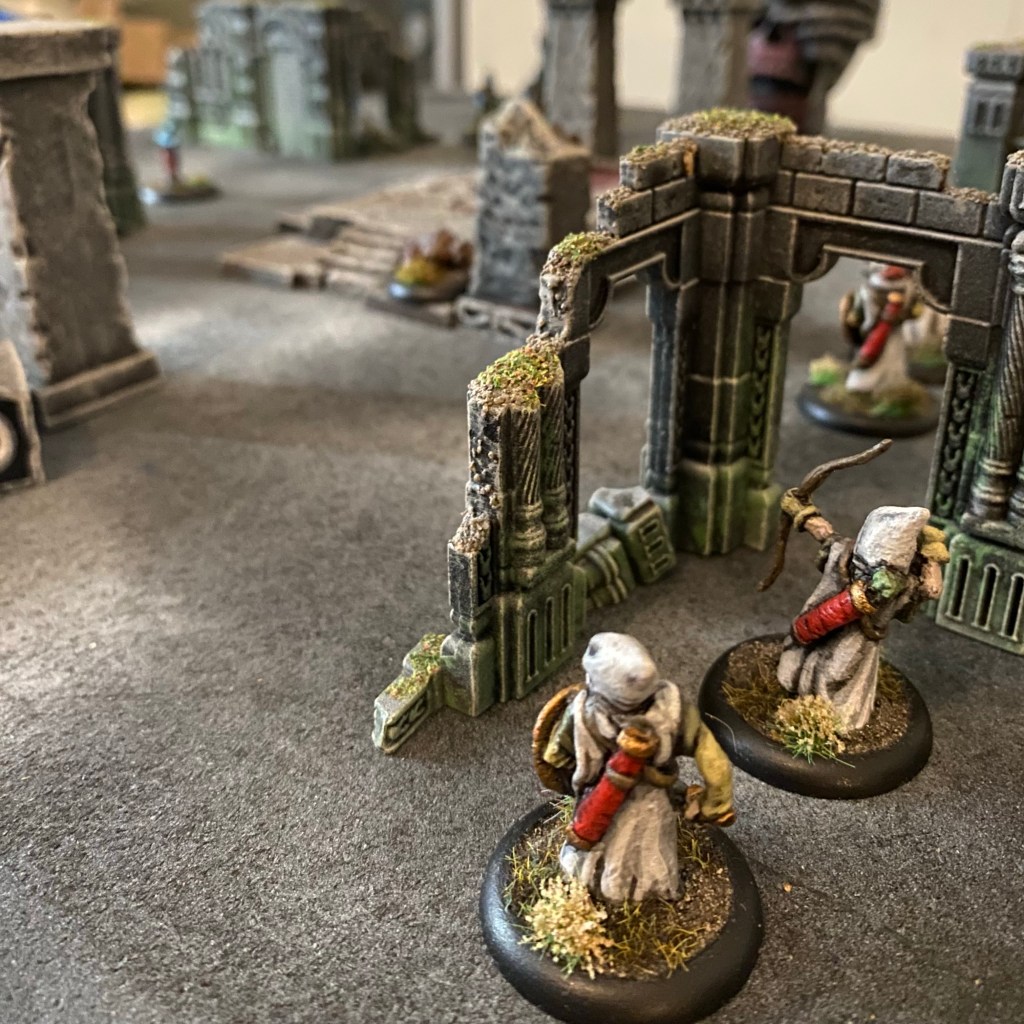
I’ve always loved the simplicity of the Simple Toy Soldier Game and how it does things far more complicated wargames don’t. I’ve always been intent on expanding it out, but one of the challenges of rules writing, especially when you’re messing with such simple and possibly elegant systems is the lack of wiggle room. A system that is designed for minimal moving parts struggles when you start shoving more parts in.
I think what my universal skirmish system has given me though is the ability to give more personality to figures without dumping on too many mechanics, this is down to its system of Archetypes: a powerful wizard and a dude with a heavy machine gun may have the same battlefield role which I’m calling ‘Gunner’.
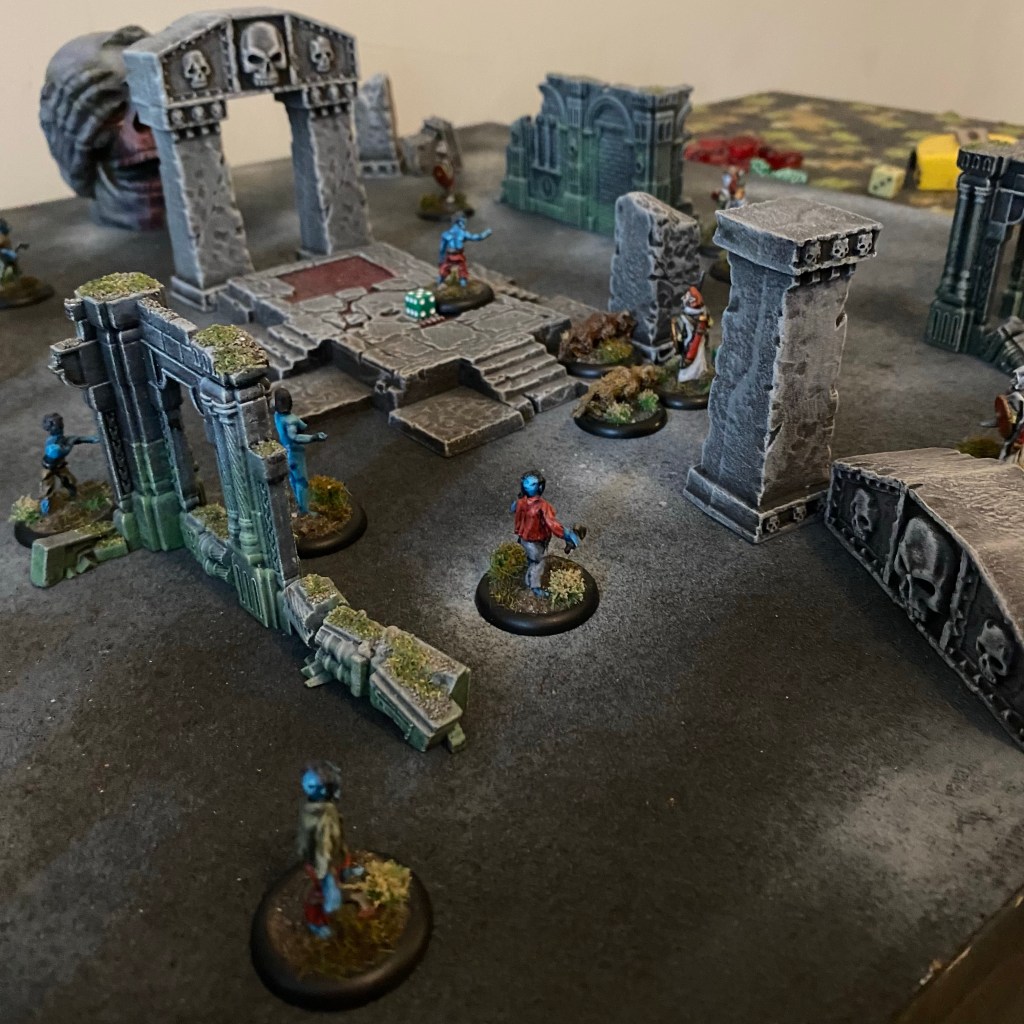
Part way through my little playtest I got sent back to the drawing board. Using the shooting mechanics of the Simple Toy Soldier Game for melee isn’t a good idea, one of the reasons I kept melee so simple in the Simple Toy Soldier Game was to not get bogged down (something which I appeared to have forgotten). The reason this works in the STSG is because it’s designed to mimic modern to futuristic warfare with guns, where melee is quick and brutal and ultimately not a main focus in the rules themselves. However with the more general approach that my universal rules are taking melee is on an equal pegging with shooting, and so leaving it as an afterthought or necessary evil doesn’t quite work.

A big drawback I was finding with both sets of rules was all the on table bookkeeping. Has a figure activated? How much damage have they received? What other status effects are at play? How much danger has a figure received? There were a lot of dice and counters hanging around and I prefer a clean tabletop.
The other thing is like to address is the speed of the game, I’d like to be able to resolve battles within 15-30 minutes, so I can play multiple games in an evening, or just squeeze a quick one in when I’ve got a bit of free time.
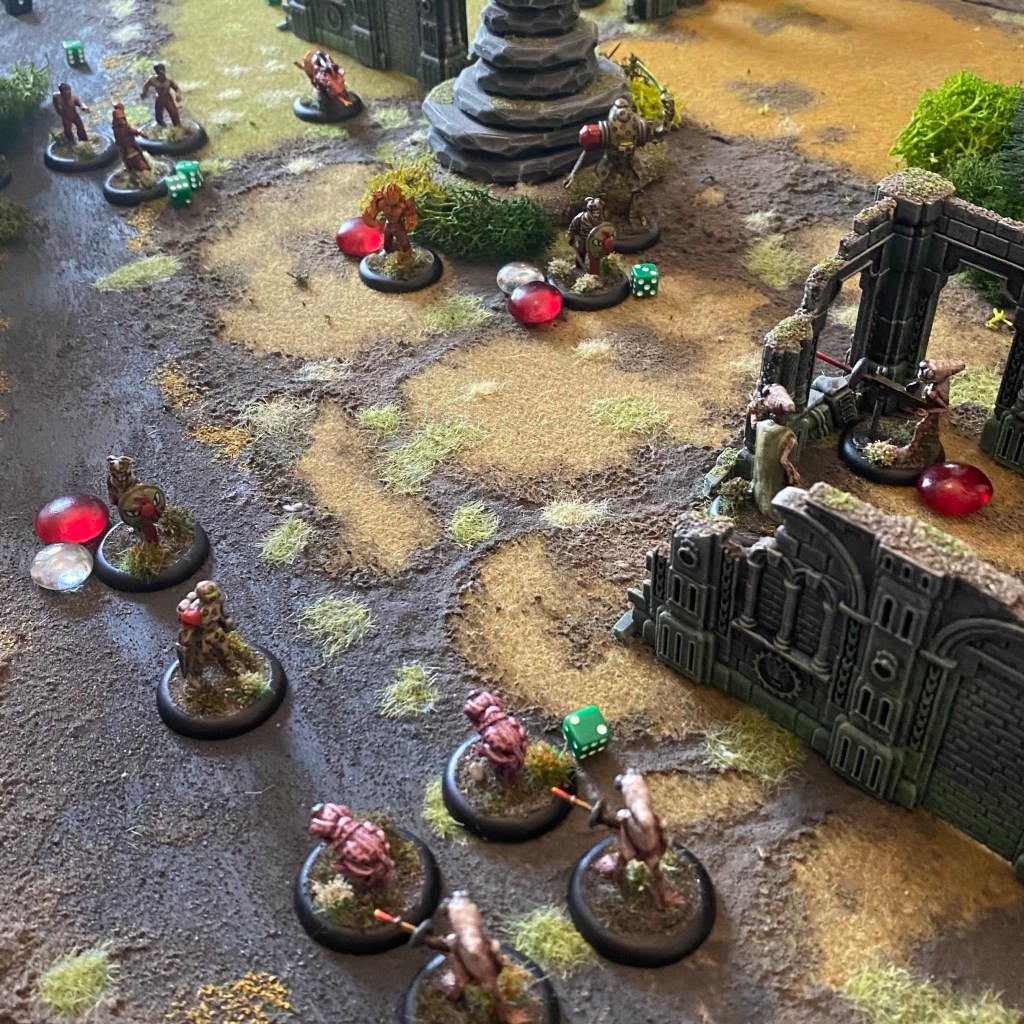
So here’s an attempt at a minimal clutter style game, one of the mechanics I’m particularly interested in exploring is how activations work. I’ve done away with all that ‘game turn’ broken up into ‘player turns’ blah blah, hopefully it works. A couple of test games went well. Let me know your thoughts.
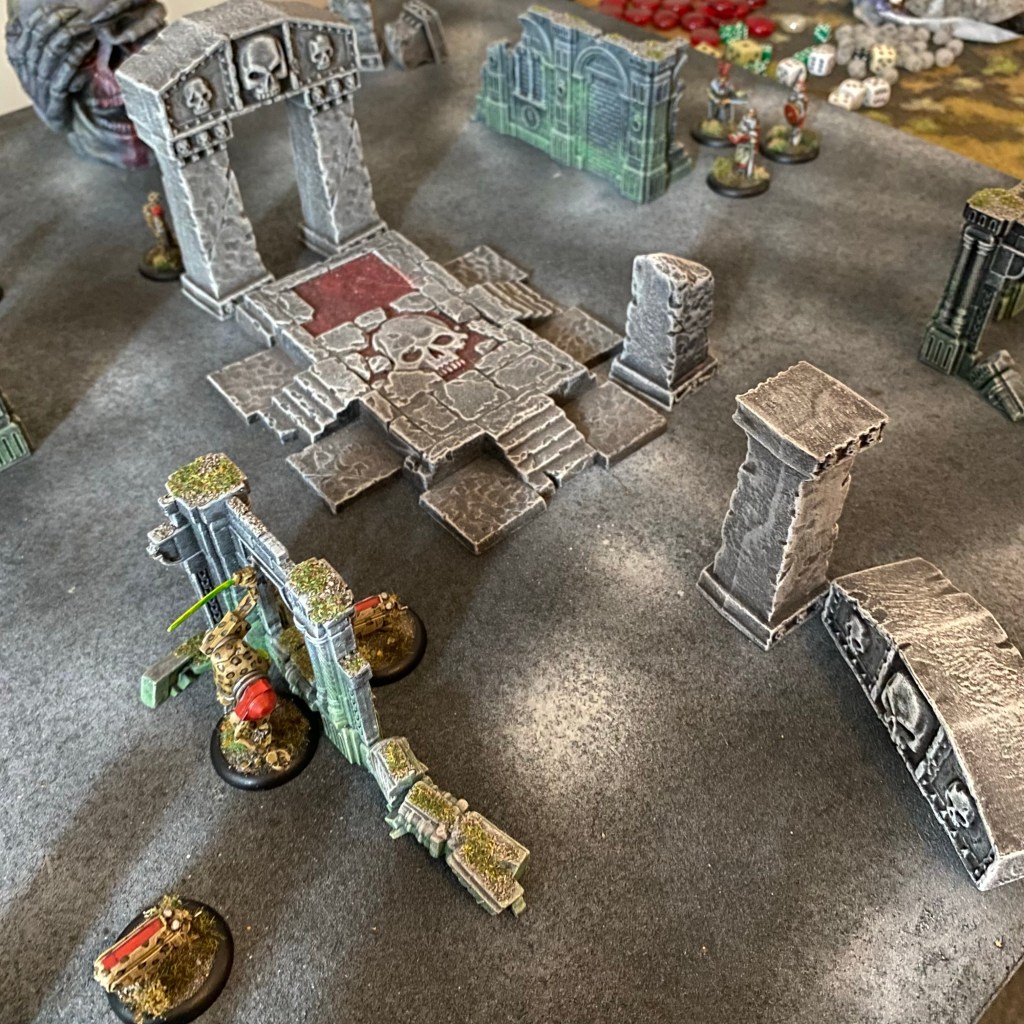
I definitely did not achieve my goal of merging the STSG and my Universal Skirmish Rules!
WARBANDS AND FIGHTERS
Each player has a warband. A warband is made up of fighters. Each fighter has a class and one stat: Might. There are 10 available classes
Basic – Soldier, Warrior, Beast, Drone.
Special – Gunner, Berserker, Sniper, Gunslinger.
Rare – Monster, Mech.
The cost of a fighter is equal to their Might value. A standard game is 20 points, and you can have a maximum of 10 fighters. Additionally at least half of your total number of fighters must be made up of basic classes and you can have a maximum of 2 fighters with a rare class.
THE GAME BOARD AND DEPLOYMENT
Games are played on a 24”x24” board. Place a single Shrine in the centre of the playing area. Player’s roll off and the higher roller chooses which starting edge they would like and deploys their fighters within 6” of that edge. Their opponent then takes the opposite edge and deploys their fighters within 6” of it.
ACTIVATIONS
The player that deployed second is the activate player and can pick any of their fighters to activate.
Once that fighter has activated:
If they attacked an enemy but did not kill them, that enemy is activated, and the other player becomes the active player.
If they attacked an enemy and did kill them, then the active player can pick a different fighter to activate (unless they only have one fighter remaining in which case that fighter can activate again).
If they did not attack an enemy, then the other player becomes the active player and can pick any fighter to activate.
When a fighter is activated they get 2 actions. A stunned fighter only gets 1 action, but is then no longer stunned. A fighter that was just wounded also counts as being stunned.
ACTION – MOVE
A fighter can move up to 3”. Beasts and Drones can move 4”. Fighters cannot move through other fighters and should use terrain in a way that makes sense.
ACTION – CHARGE (Beasts, Warriors, Berserkers, Gunslingers and Monsters Only)
If a fighter makes a normal move as above and ends up in base to base contact with an enemy they can make a melee attack as part of the same action.
ACTION – MELEE ATTACK
A fighter attacks an enemy in base to base contact.
A fighter rolls 3 dice as standard for the attack.
Berserkers and Monsters roll 4 dice.
To hit their target the fighter must pass an attack check. Compare the attacker’s Might to the target’s Might and roll 1D6 on the table below:
The Attacker’s Might is…
Double or more than double each 2+ is a hit.
More but less than double each 3+ is a hit.
Equal to, each 4+ is a hit.
Less than, but more than half, each 5+ is a hit.
Half or less than half, each 6 is a hit.
Natural 6s always hit.
If the attacker scores 1 hit the target is stunned.
If the attacker scores 2 hits the target is wounded.
If the attacker scores 3 hits the target is killed.
If a wounded fighter is wounded a second time then they are killed.
ACTION – RANGED ATTACK (Soldiers, Drones, Gunners, Snipers, Gunslingers, Monsters and Mechs only)
A fighter attacks an enemy at range.
A fighter rolls 3 dice as standard for the attack.
Gunners and Mechs roll 4 dice.
Gunslingers roll 4 dice when attacking an enemy within 6”.
To hit their target the fighter must pass an attack check. Compare the attacker’s Might to the target’s Might and roll 1D6 on the same table as for melee attacks.
If the target is not entirely visible to the attacker the attacker receives a -1 modifier to all of their rolls.
Snipers always hit on natural 4s, 5s and 6s.
Natural 6s always hit.
If the attacker scores 1 hit the target is stunned.
If the attacker scores 2 hits the target is wounded.
If the attacker scores 3 hits the target is killed.
If a wounded fighter is wounded a second time then they are killed.
ACTION – DEFENDING (Warriors, Berserkers, Monsters and Mechs Only)
A fighter will stay defending until they are next activated. When a fighter defends, enemies attacking them receive a -1 modifier to all of their rolls.
ACTION – BOOST
If a fighter boosts and then attacks in the same activation that fighter can roll an additional die for the attack.
MORALE
Whenever you kill an enemy fighter, before continuing the game you try to break the enemy morale. Roll a die and multiply it by the number of enemy fighters killed so far. Your opponent then rolls a die and multiplies it by the number of fighters they have remaining. If you score higher than your opponent then the enemy force’s morale breaks and they are defeated. If your opponent scores equal or higher then the game continues.

 Deathzap