Many dead ends, many bad mechanics, and many boring ones too. Writing Wrestling rules, or any predominantly 1v1 wargame ruleset is maybe… the biggest rules writing challenge possible? Well if you want them to be good and fun that is.
But here’s the current state of play:
Deathslam
Wrestler Attributes
Allocate 20 points across the following traits (minimum 2, maximum 5):
- Speed (SPD): The speed of a Wrestler, which determines initiative.
- Strikes (STR): Strikes, chops, and weapon attacks.
- Slams (SLM): Powerbombs, Suplexes, DDTs.
- Submissions (SUB): Sharpshooters, Crossfaces, Anklelocks, Armbars.
- Aerials (ARL): Frog Splashes, Bodyslams, Flying Elbows.
- Crowd Support (CSP): A Wrestler has Crowd Support which is the number of points spent on this stat x5. Crowd Support determines a Wrestler’s ability to take damage and when a wrestler can be pinned.
- A Wrestler has a Finishing Move, this move uses one of their stats, STR for wrestlers that are brawlers and martial artists, SLM for wrestlers that prefer slams, SUB for technical Wrestlers, or ARL for fast movers and high flyers. Make a note of which stat the wrestler will use for their Finishing Move, and give their Finishing Move a cool name.
- A Wrestler can also be a Face or a Heel. Faces get +5 Crowd Support, whereas Heels can use Dirty Tactics.
Managers
If a wrestler has a manager at ringside, choose one archetype before the match:
- The Hype Man: Once per match, instantly gain +1 Momentum Point.
- The Cheat: Once per match, you can reroll a failed Dirty Tactic check.
- The Medic: Once per match, when your wrestler kicks out of a pin, they recover 3 additional Crowd Support.
- Managers may also get involved in the action from time to time, or be attacked, for this reason stat up a manager as if they were a Wrestler, however as managers are generally weaker than Wrestlers you only have 13 points to allocate to their traits.
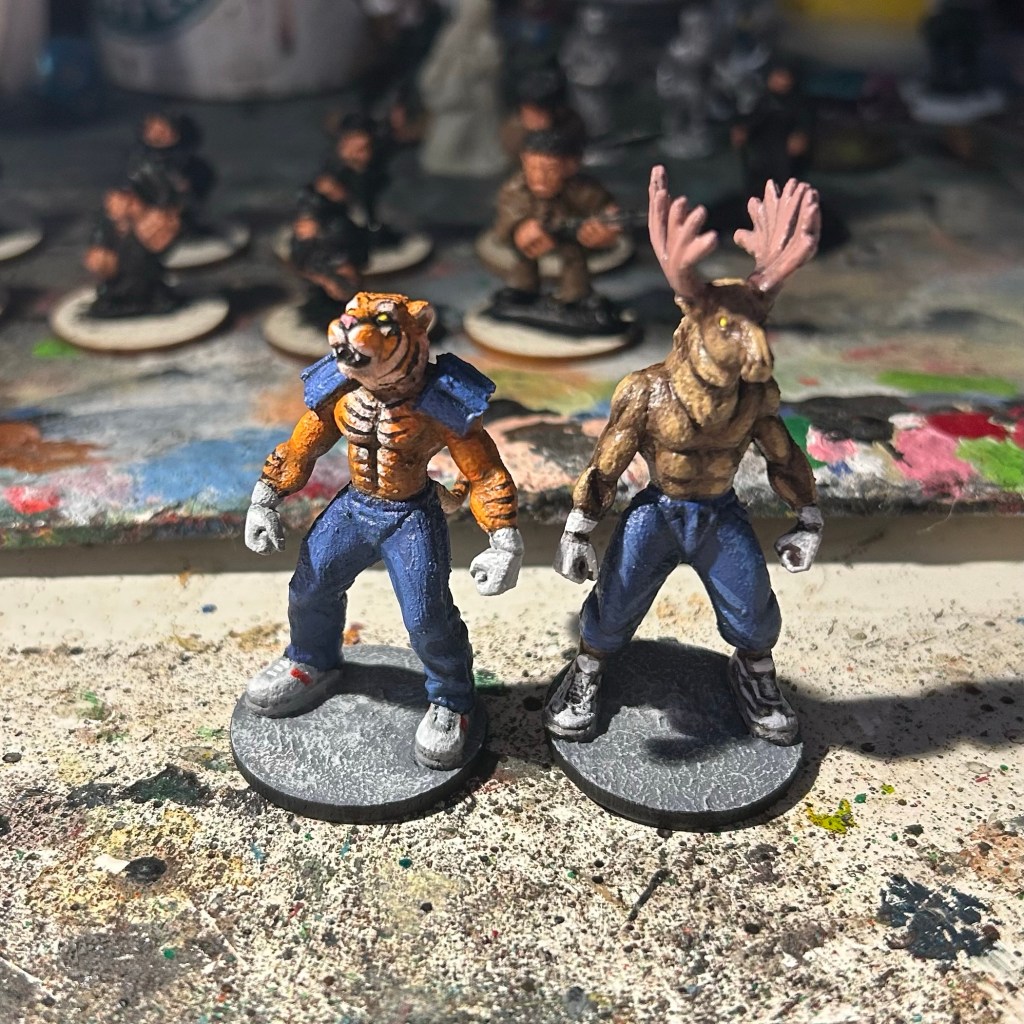
Core Match Mechanics
Movement and Facing
The arena is divided up into a 5×5 grid of squares, with the middle 9 squares (a grid of 3×3) making up the ring. Opposing Wrestlers always begin in diagonally opposite corners of the ring, facing each other, with any tag team partners or managers on the outside of the ring in a square adjacent to their allied Wrestler.
Only a single miniature can occupy any single square at a time.
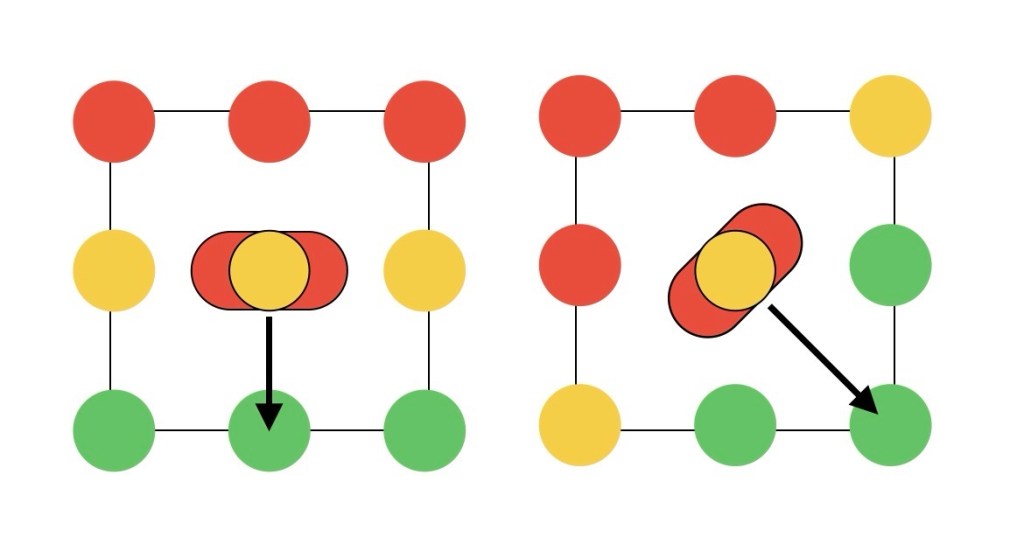
The direction a Wrestler is facing matters. A Wrestler can face a side, or corner of the square that they are in. Imagine the square that they are in has eight points, one for each side, and one for each corner. The point that they are facing, and the two adjacent points are the Wrestler’s front facing. The point directly behind the Wrestler, and its two adjacent points are the Wrestler’s rear, the two remaining points are the Wrestler’s sides. See below (front in green, sides yellow, rear red):
Standard Round Sequence
Phase A: Initiative
Roll for both Wrestlers’ initiative on a D6 each. The higher total becomes the Attacking Wrestler after any relevant bonuses are applied below:
Facing Opponent’s side +1
Facing Opponent’s rear +2
Opponent lying down +2, facing doesn’t apply to Wrestlers that are lying down.
The Wrestler with the higher speed value +1, if their speed value is double, or more than double their opponent’s +2.
In the case of a tie, the Wrestler with the higher Speed stat wins, in the case of a further tie, keep rolling off (without bonuses) until a winner is found.
The Attacking Wrestler then gains a number of Stamina Points (SPs) equal to the difference between the two scores.

Phase B: Actions
During this phase the Attacking Wrestler can spend their Stamina Points to move (walk, run, climb etc.), or choose an action (a wrestling move).
If the Wrestler chooses to move, they can move 1 space and then change their facing to any direction for 1 Stamina Point. A Wrestler does not have to move in the direction that they are facing.
If a Wrestler is lying down they must spend a Stamina point to stand, before moving or attacking.
When the Attacker chooses an action, they must be facing their opponent and in an adjacent square, their opponent does not have to be facing them (Aerial moves work slightly differently, see below). First roll to hit and then apply damage if a hit is achieved. Damage is determined by the Attacking Wrestler’s relevant stat, Strike, Slam, Submission or Aerial, plus the Action’s Damage modifier.
A result of less than the hit roll means the move has been botched and no damage is dealt, however the SPs are still expended.
A hit roll of a natural 1, means the Defender has reversed the move. The Defender immediately becomes the Attacker, and gains all remaining SPs.
Action: Strike – 2+ to hit, no damage modifier. Cost: 1SP.
Action: Slam – 4+ to hit, +3 damage. Cost: 2SPs. If a hit is achieved the Defending Wrestler lands in an adjacent square to the Attacking Wrestler chosen by the Attacking Wrestler’s Player, and is lying down. If the Defending Wrestler lands outside of the ring, they suffer 1 additional damage.
If the Defending Wrestler lands on another Wrestler, that Wrestler moves out of the way to an adjacent square of their choice and takes 1 damage.
Action: Submission – 3+ to hit, +1 damage. Cost: 2SPs. Roll a D6 after damage is resolved, and if the result is higher than the Defending Wrestler’s remaining Crowd Support, they Tap Out and lose the match.
Action: Aerial – 4+ to hit, 3+ to hit if the Defending Wrestler is lying down. +3 damage. Cost: 2SPs. Only possible if the Attacking Wrestler is adjacent to a turnbuckle or within the ring while the Defending Wrestler is outside of the ring, and the Defending Wrestler is within 2 spaces of the Attacking Wrestler. If the move hits, the Attacking Wrestler finishes their move in a space adjacent to the Defending Wrestler, chosen by the Attacker’s player. If the Attacking Wrestler fails to hit with their move, they finish in a random space adjacent to the Defending Wrestler, suffer D3 damage, finish lying down, and lose all remaining Stamina Points. If the Attacking Wrestler lands outside of the ring, they suffer 1 additional damage.
Once the Attacking Wrestler has run out of SPs, return to Phase A.
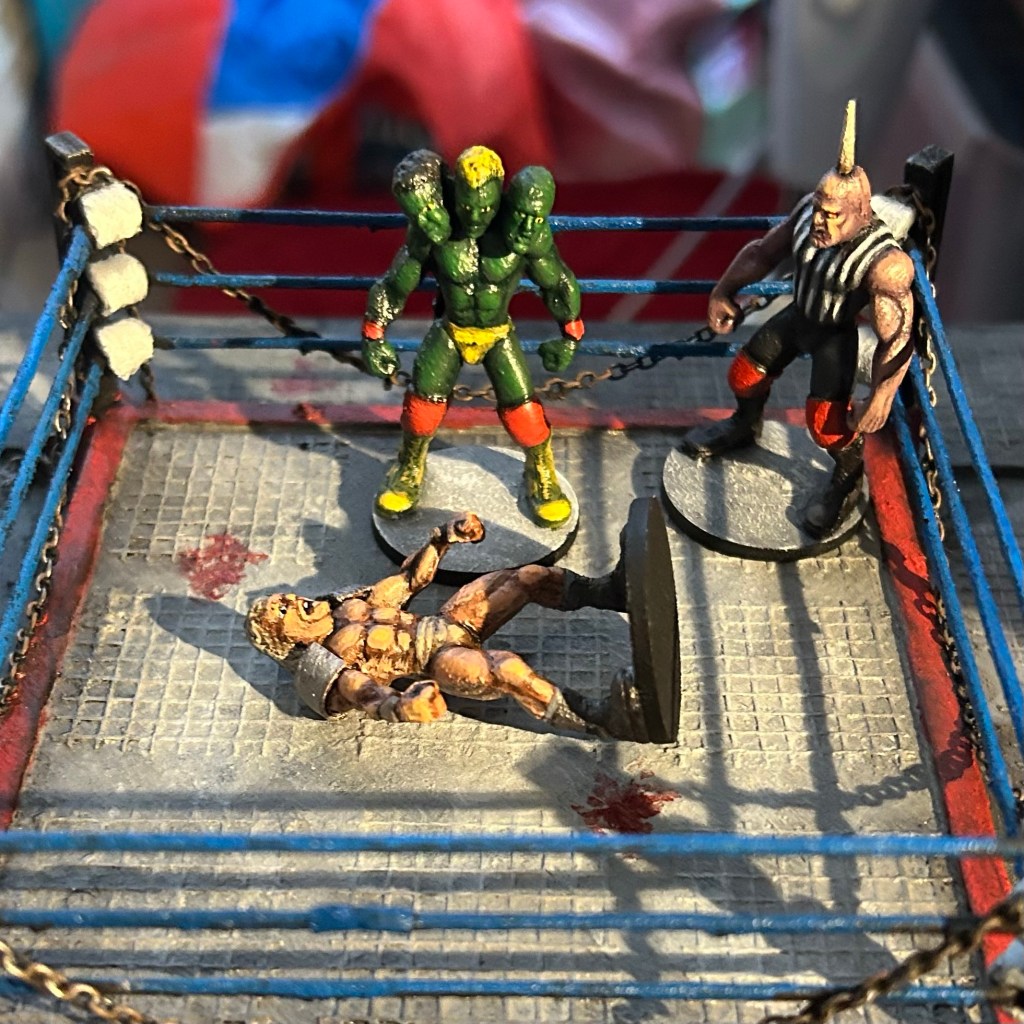
The 1-2-3 Pinfall
The Attacking Wrestler can attempt a Pinfall during Phase B instead of a move, if the Defender’s Crowd Support is under 5. A Pinfall costs 1SP.
If the Attacker rolls a D6 above the Defender’s remaining Crowd Support, the Defender does not kick out and the match is over. A natural 1 always fails.
If the Defender kicks out, they recover 5 Crowd Support. Both Wrestlers stand if they weren’t already. Then a new round begins, meaning neither wrestler is Attacking or Defending, so go to Phase A.
Dirty Tactics
Once per match, a Heel (villain) can attempt a dirty tactic (e.g. a low blow or eye poke) in Phase B if they are the Defending Wrestler. Declare your Wrestler is going for this tactic between the opponent’s moves. The Heel rolls for a Strike. If Successful: The Defender immediately becomes the Attacker, and gains all remaining SPs, and their opponent takes damage from the strike as normal. Botch (Disqualification): On a natural roll of 1 the referee spots it. The Defending Wrestler is immediately disqualified, and the match is over. Remember, if the Wrestler has a Cheat archetype manager they can reroll the die!
Momentum And Finishing Moves
Gaining Momentum: Every time a Wrestler successfully pulls off a Wrestling move, they gain 1 Momentum Point. At 5 Momentum Points, that Wrestler can choose to unleash their Finisher during Phase B.
The Execution: The Attacker rolls for the relevant attack type (Strike, Slam, Submission or Aerial). If it hits, the Attacker deals damage with a +3 damage modifier. A pinfall attempt can be made immediately after the move is resolved for 0SPs with a +2 bonus to the roll and even if the Defender’s Crowd Support is more than 5. Submission moves follow the rules for a pin attempt as above, instead of the Tap Out (though you can still imagine it was a Tap Out).
KOs
If a Finishing Move would take a wrestler below 0 Crowd Support, then that wrestler is KO’d, and immediately loses the match.
Bouts
As matches can be over quickly, you could consider playing a match out over a number of bouts (2-5). So play as above, however for every bout before the last, a Wrestler ‘loses’ when they are reduced to 0 or less Crowd Support. Wrestlers then return to their corners, and a new bout is played, with each wrestler returning to their starting Crowd Support, however each Wrestler gains +5 Crowd Support for each previous bout that they won.
Pinfalls, Tap Outs and KOs are only possible in the final bout played, and determine the winner of the match regardless of the number of bouts won by each wrestler previously.
Disqualifications do end the match immediately.
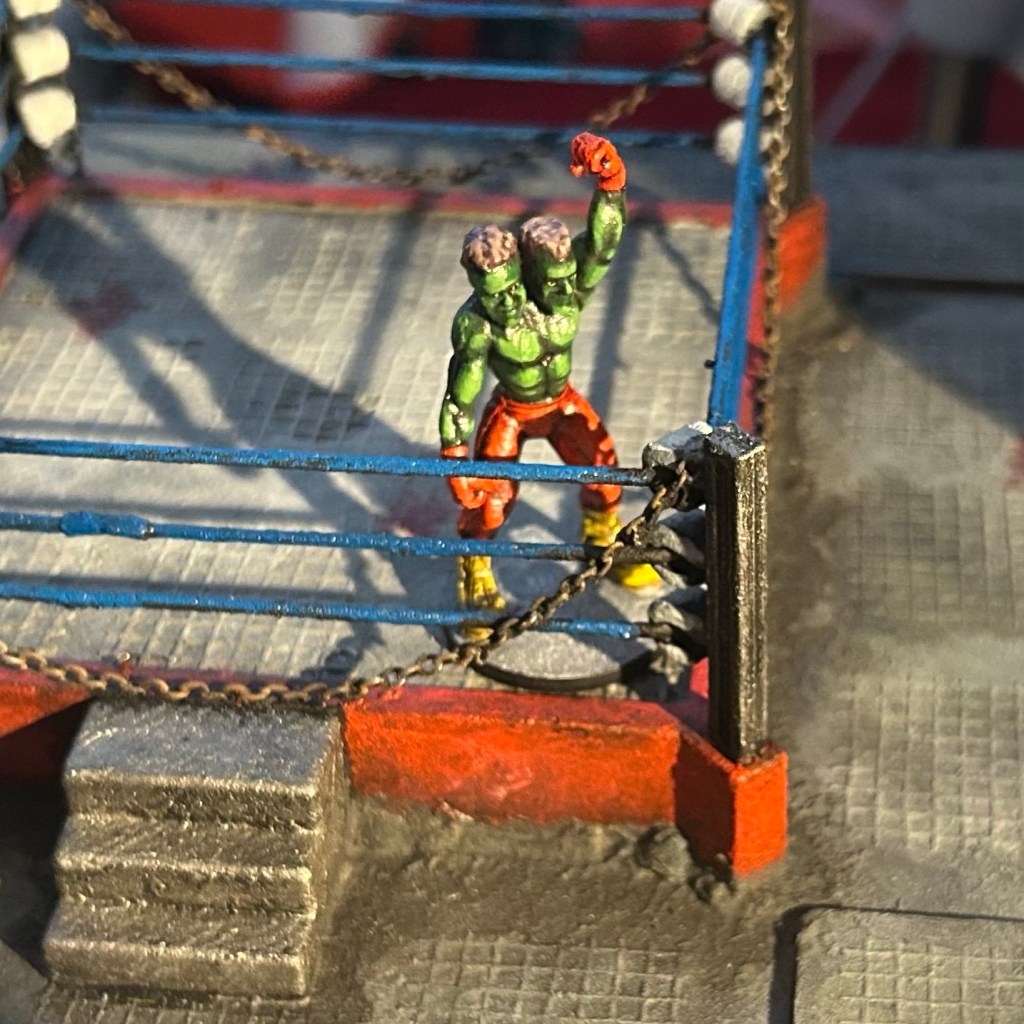
There’s obviously a lot more to add. Different match types being a must, from Hardcore, to Tag Team, to my absolute favourite The Royal Rumble. I think Wrestler progression is a must, alongside some kind of relationship mechanic so allies and enemies can be gained by wrestlers (this is a soap opera after all).
There’s a few wrestling staples I also haven’t managed to include yet, like repositioning your opponent (not just yourself), like an Irish whip into the ropes so you can land that clothesline, or throwing someone into a turnbuckle so you can slam them into the mat from higher up.
Things I mentioned before but haven’t quite figured out yet are referees (bar the basics already included) and managers could do with more development. Plus I need to start developing the ‘mutant’ aspect a lot more. These aren’t your average wrestlers they’re superhuman freaks with a penchant for violence.


Nice work on the figures and setting. The rules are clever.