All wargames are abstractions as you simply can’t represent every single minute detail of a real battle on the tabletop. So rules writers learn to pick their battles, chopping and changing their perceived experience of real war into the bits that they deem most important. This week I was mulling over my massive list of weapons for Ghost Legions, and I started really wondering about this abstraction process.

Being a child of Warhammer 40,000, of course for me the most important stuff is weapons and armour. Weapon stats like range, rate of fire, accuracy, armour penetration and damage seem to make sense to me, though admittedly you could easily merge most of them into something simple like ‘Fire Power’. Come to think of it ‘toughness’ and ‘wounds’ seem to also represent the same thing.
In reality, I suppose morale and command are probably far more important than any super weapon, however rules designers likely want the ‘command’ bit to be taken care of by the players own generalship.

Maybe the most abstract wargame I have played is Havok. A wargame essentially designed for kids, but it certainly had enough depth to still be interesting. It was certainly a pleasant surprise for me, when I finally gave playing it a go, how well the rules worked. Though they did have missing bits, they didn’t feel missing when you were playing. Even though guns only get a single stat!

So… to ask an unfair question, if you had to pick one thing that would be the most important in representing a battle on the tabletop (like picking your favourite child), from skirmishing up to a big battle, what to your mind would that thing be? Terrain? It’s probably terrain isn’t it. Kind of odd then terrain is often the afterthought in a ruleset?

So how abstract could you go? This is a personal taste thing, but as I was playing Havok, strangely I found the abstraction fired my imagination. I think because when all the ins and outs of a ranged attack aren’t so defined and refined, your brain fills in the gaps, which made things feel a bit more fun. I was actually playing with my toy soldiers, rather than playing with my toy soldiers. Yes, there is a difference.
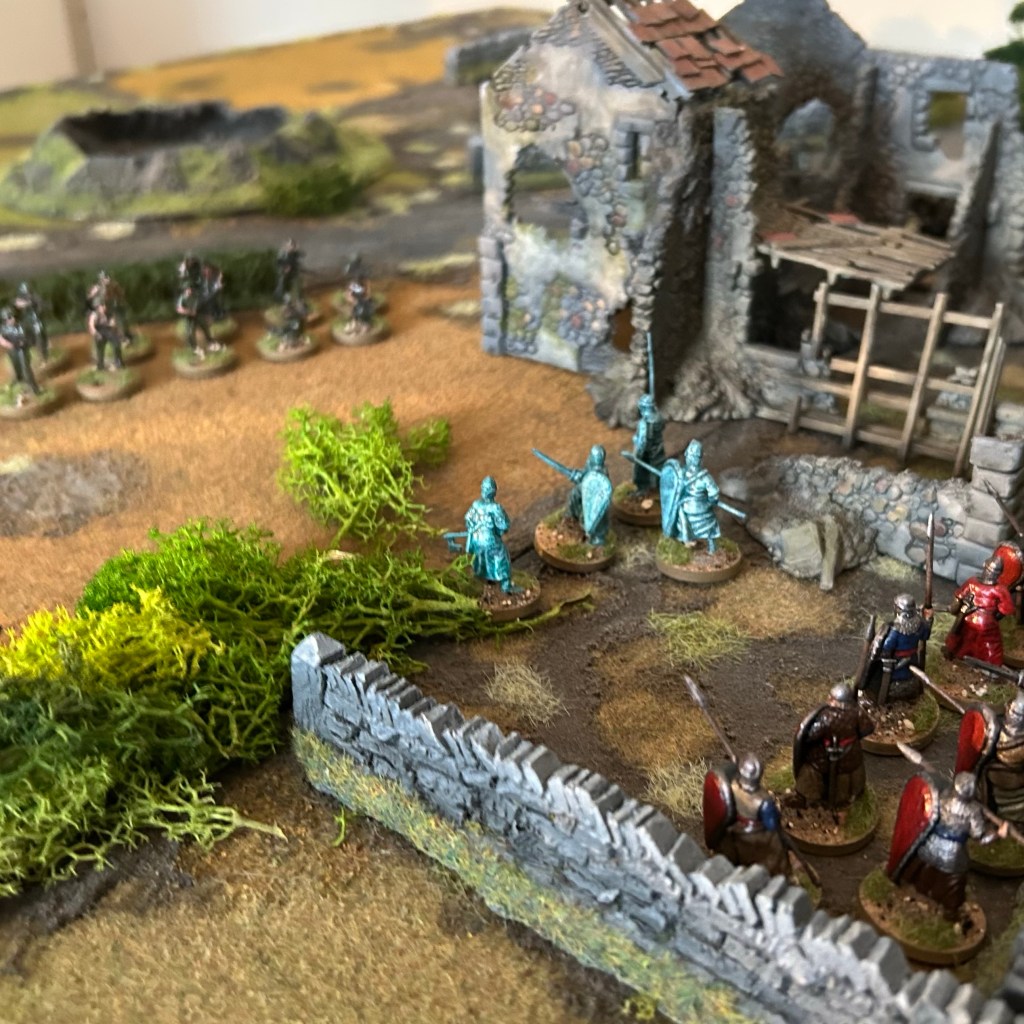
Maybe Ghost Legions is fertile ground for a good amount of abstraction, without aping off of Heroscape too much.
I did scribble something in the notes app on my phone, and I wonder if it’s got legs:
Models have 3 stats, Speed, Range and Power.
Turn Structure
During a player’s turn, they can move each of their models once (up to their Speed value), and then if possible attack with each of their models any number of times.
Movement
When a model moves its speed is affected by terrain.
To cross an obstacle like a low wall or hedge costs 1”.
When moving through rough terrain, each inch moved counts as two.
Combat
An attacker must select a target enemy that is within their range and that they can see.
A model can only kill another that is within range. So if the target of an attack wins combat, but their attacker was not in range of their (the target’s) weapons, then the attacker is not killed, the target just survives the attack.
To attack, the attacker rolls 1 die per point of power that they have. Each 4+ is a success and each 6 allows another die to be rolled.
The target then does the same.
The model with the highest number of successes wins combat, and if their opponent is within their range, then their opponent is killed.
In the case of a tie, the attacker wins combat and the target is killed.
If a model fights more than once in a single turn (either of its own choosing or because it has been attacked multiple times by enemy models) each time it does so its power value is decreased by 1 down to a minimum of 1.
If an attacking model fails to kill a target, and also survives, that model cannot attack again in the same turn.
An attacking model can only select a new target that is within 2” of itself, or was within 2” of its previously killed target.
If a model has cover from the point of view of their attacker, when they are attacked, they can make a saving throw if they lose combat. For soft cover a 5+ will save them. For hard cover a 4+ will save them.
If during a model’s turn, if it kills an enemy in base contact, that model can then make an extra 2” move to try and get into base contact with another enemy model.


